Showing posts with label richard gere. Show all posts

Friday, April 12, 2013

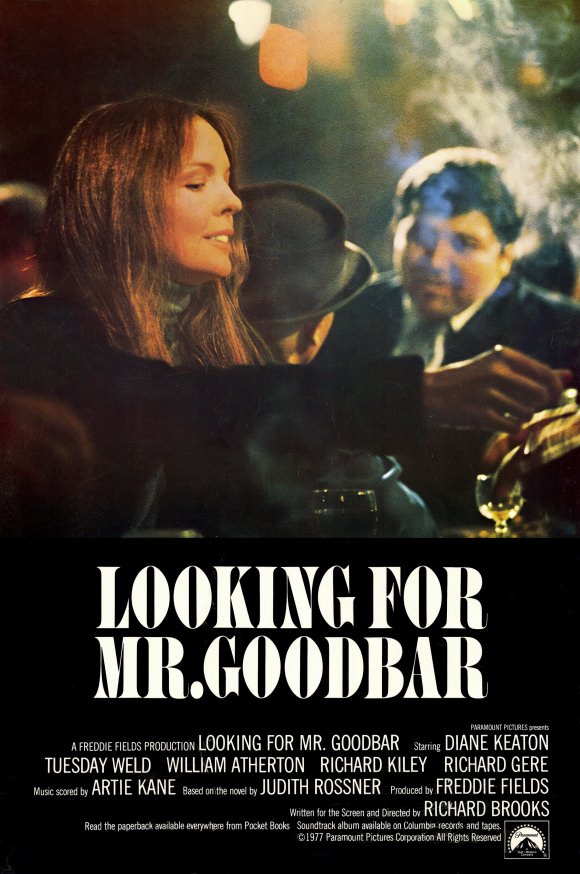
Looking for Mr. Goodbar (1977)


          A dark meditation on the Sexual Revolution that caroms wildly between sensitive vignettes and overwrought climaxes, Looking for Mr. Goodbar divided audiences during its original release but has since attained cult-movie notoriety, especially because, as of this writing, it has yet to be released on DVD or Blu-Ray. (Falling into obscurity often boosts a once-popular film’s reputation.) Adapted from a best-selling novel by Judith Rossner and written and directed by uncompromising auteur Richard Brooks, the movie is a cautionary tale, but it’s not entirely clear what Brooks wants to caution viewers against. Sometimes, it seems as if he’s castigating his lead character, a young professional woman with a wild sex life, for the sin of seeking physical fulfillment. At other times, it seems as if the villain of the piece is the lead character’s recklessness. And thanks to a gruesome narrative turn during the story’s third act, an implication is communicated that homosexuality is a malignant societal force. Suffice to say, the sexual politics of the movie have not aged well.
        Yet certain elements of the picture probably seemed damned weird right from the get-go—consider the awkward device of grown-up star Diane Keaton playing her character during college scenes, or such surrealistic flourishes as the trippy visual effect that’s featured during the final shots of the movie. In fact, Brooks takes a gonzo storytelling approach from start to finish simply by pitching the intensity level of key scenes absurdly high. Were it not for the supple textures of Keaton’s performance, Looking for Mr. Goodbar would feel like a cartoon, albeit a nihilistic one.
          The story follows Teresa (Keaton), a good girl from a religious New York City-area family, as she matures professionally and sexually. Following an eye-opening dalliance with her college professor, Teresa takes a job as a teacher at a school for deaf children, so right from the beginning of this young woman’s journey, her intellectual and physical lives are intertwined. Teresa’s older sister, Katherine (Tuesday Weld), is a high-strung swinger who gets in too deep with a sexually adventurous man, but instead of being frightened by Katherine’s experiences, Teresa is titillated.
          Soon, Teresa enters the swinger world and gets involved with men including Tony (Richard Gere), a small-time crook who introduces Teresa to cocaine. (One memorably campy scene features Tony, jacked up on blow, doing push-ups in Teresa’s apartment while wearing nothing but a jockstrap.) Teresa also becomes involved with James (William Atherton), a social worker who represents a “safe” choice of romantic partner. However, she shuns his old-fashioned normalcy in favor of freakier delights. Eventually, Teresa’s sexual wanderlust lands her in bed with Gary (Tom Berenger), a sexually confused young man with a prison record, which instigates the movie’s infamous final scene.
          Looking for Mr. Goodbar is strange on many levels, but the most noteworthy cinematic disharmony is the rift between the story Brooks is telling and the one Keaton is telling. Brooks delivers every narrative assertion with an exclamation point, eschewing subtlety for hand-wringing histrionics. Meanwhile, Keaton does extraordinary work, imbuing her performance with naturalism and spontaneity. In essence, Brooks tries to make a Grand Statement while Keaton sketches a character study. This has the effect of making Keaton feel separate from the rest of the movie, especially when Gere over-acts his way through a ridiculous performance that Brooks should have restrained. And while supporting players including Atherton, Richard Kiley, and Priscilla Pointer all deliver competent work, the only actor who achieves the same level of nuance as Keaton is Weld, a perpetually underutilized daredevil of a performer who is capable of incandescence in the right context. (Her work in this movie earned a Best Supporting Actress Oscar nomination.) Ultimately, Looking for Mr. Goodbar is a uniquely disjointed movie—part melodrama, part tragedy, and part oh-so-’70s bummer phantasmagoria.

Looking for Mr. Goodbar: FREAKY

Friday, December 28, 2012

Report to the Commissioner (1975)


          Back in my college days, when I lived in Manhattan, I was friendly with an NYPD homicide detective who was also a movie buff, and he hipped me to this little-seen drama, praising it as one of the most accurate depictions he’d ever seen about how ugly the gamesmanship within a police force can get. And, indeed, even though Report to the Commissioner is fictional—it’s based on a novel by James Mills—the picture radiates authenticity. Extensive location photography captures the dirty heat of summertime New York City; intense performances burst with streetwise attitude; and the vicious storyline is driven by cynicism, duplicity, and politics. Told in flashback following some sort of terrible clusterfuck of a shootout at Saks Fifth Avenue, the picture reveals how an ambitious undercover detective and a rookie investigator cross paths, with tragic results.
          Michael Moriarty, appearing near the beginning of his long career, stars as hapless Detective Bo Lockley, a newcomer to the NYPD investigative squad who gets paired with a seen-it-all partner, African-American Richard “Crunch” Blackstone (Yaphet Kott0). In a telling early sequence, Lockley watches Blackstone lean on black suspects, even going so far as to spew racial epithets, which clues Lockley into the level of moral compromise required of NYPD lifers. Meanwhile, unbeknownst to Lockley, undercover narcotics cop Patty Butler (Susan Blakley), a pretty blonde WASP who uses her looks to undercut suspicions that she’s a police officer, gets a lead on a well-connected dealer named Thomas “Stick” Henderson (Tony King). Smelling an opportunity for a high-profile bust that will help his career, Butler’s commanding officer, Captain D’Angelo (Hector Elizondo), approves a dangerous plan for spying on Stick. Soon afterward, Lockley gets pulled into the situation—without being given crucial information—and things go to hell. The movie climaxes with a tense hostage situation inside Saks, during which high-ranking cops put more energy into covering their asses than saving innocent victims.
          This is dark stuff, making Report to the Commissioner a fine companion piece to Sidney Lumet’s various ’70s pictures about cops and criminals in New York City. And while Report to the Commissioner is far from perfect—the script meanders into subplots and some of the characters could have been consolidated for the purpose of clarity—the movie has myriad virtues. The atmosphere sizzles, with cinematographer Mario Tosi using haze filters and wide lenses to depict grungy exteriors and sweaty interiors. Director Milton Katselas, best known as an acting teacher, demonstrates a real gift for integrating actors into spaces and thereby creating verisimilitude. Best of all, though, are the film’s potent performances. Blakely’s sharp in a smallish role, King is physically and verbally impressive, and Moriarty’s weirdly twitchy energy is compelling. Furthermore, it’s hard to beat the roster of eclectic supporting players—beyond Elizondo and Kotto, the picture features Bob Balaban, William Devane, Dana Elcar, Richard Gere (in his first film role), and Vic Tayback. (Available as part of the MGM Limited Collection on Amazon.com)

Report to the Commissioner: RIGHT ON

Sunday, November 11, 2012

Baby Blue Marine (1976)


          Even though Baby Blue Marine tries to accomplish too much, resulting in narrative muddiness, every quality to which the movie aspires is commendable. Set during World War II, the picture follows the exploits of Marion (Jan-Michael Vincent), a gung-ho youth who gets kicked out of the Marines during basic training for failing to meet basic proficiency requirements. (Never mind that Vincent is in extraordinary shape, or that his character is shown to possess bravery, intelligence, and leadership—not exactly the traits of a likely washout.) Making his way home from boot camp to St. Louis, while wearing the demeaning “baby blue” uniform of a reject, Marion gets assaulted by a combat veteran (Richard Gere) who steals Marion’s clothing as a ruse for escaping the military. (Again, never mind that Gere’s character could simply have bought street clothes.) Now dressed as a decorated soldier, Marion hitchhikes toward a small town in the Northwest, where he’s taken in by sweet-natured teen waitress Rose (Glynnis O’Connor) and her family. Eventually, Marion gets called into action when three young Japanese-Americans escape from an internment camp, so Marion—oh, the irony!—becomes the voice of pacifism when hotheads seek to hunt down the escapees.
          TV-trained writer Stanford Whitmore’s script is contrived but offbeat, while director John Hancock’s storytelling is blunt and mechanical, but Baby Blue Marine means well. Themes of courage, decency, and humanism are always welcome, and everyone learns a tidy little lesson at the end of the picture, Afterschool Special-style. Plus, the movie looks much better than it should, because the great cinematographer László Kovács fills Hancock’s bland frames with nuanced lighting. The acting is generally underwhelming, with Vincent going for a babe-in-the-woods dreaminess that makes him seem detached during many scenes; meanwhile, supporting players including Dana Elcar, Katherine Helmond, and Burt Remsen are hamstrung by trite dialogue. (O’Connor comes across as sweet and warm, but her work is not especially memorable.) However, Bruno Kirby makes a strong impression in the opening scenes as one of Marion’s fellow ne’er-do-well recruits, and Art Lund provides gravitas as a small-town dad mourning the battlefield death of his son.

Baby Blue Marine: FUNKY

Monday, August 20, 2012

Days of Heaven (1978)


          Much of the mythology surrounding enigmatic filmmaker Terrence Malick stems from the making and aftermath of his sophomore feature, Days of Heaven. Following idiosyncratic artistic instincts rather than Hollywood convention, Malick took nearly three years to craft this moodily poetic work, which treats its simplistic storyline like an afterthought. During that time, rumors spread about the director’s offbeat methods: For instance, he dictated that large sections of the film be shot at dusk, thereby abbreviating many of his shooting days to short bursts of activity. Then, after the film received a mixed critical reception, Malick disappeared from the Hollywood scene for 20 years. His mysterious withdrawal cast Malick as an artist too pure for the crass ways of Hollywood, triggering years of reappraisal and rediscovery.
          By the time Malick resumed directing with The Thin Red Line in 1998, Days of Heaven was firmly entrenched alongside the director’s debut feature, Badlands(1973), as one of the most respected films of the ’70s. Does it deserve such rarified status? Yes and no. Visually, Days of Heaven is unparalleled. Malick and cinematographers Nestor Almendros and Haskell Wexler mimicked turn-of-the-century paintings and photographs to evoke the supple textures of a Texas wheat farm circa 1916, the movie’s central location. Malick presents several astoundingly beautiful scenes of workers wading through fields, their bodies silhouetted against pastel-colored sunsets, while composer Ennio Morricone’s lilting music evokes a time when life moved at a more contemplative pace.
          Working with frequent collaborator Jack Fisk (credited here as art director), Malick oversaw the creation of a remarkable focal point, the elegant mansion that sits atop a wheat-covered hill, and Malick uses this structure as an effective metaphor for man’s tumultuous relationship with nature: Not only is the house a shelter during weather, it’s a place where relationships that had previously been allowed to roam freely get trapped within the conventions of propriety.
          The main plot, which never quite gels because Malick leaves many details unexplained and/or unexplored, begins in Chicago. Traveling workman Bill (Richard Gere), his girlfriend Abby (Brooke Adams), and his little sister Linda (Linda Manz) flee Chicago after Bill kills a supervisor during an argument. Upon reaching Texas, the trio accepts work on the wheat farm, which is owned by a sickly man identified only as The Farmer (Sam Shepard). For murky narrative reasons, Bill and Abby pretend to be brother and sister instead of a couple. So, when The Farmer becomes interested in Abby, Bill encourages the romance—believing The Farmer is terminally ill, Bill hopes to seize The Farmer’s wealth through marriage and build a new life for his family. Unfortunately, complications ensue, leading to heartbreak and tragedy.
          Despite the gifts for incisive storytelling he displayed in Badlands, Malcik badly fumbles basic narrative elements in Days of Heaven. His characters are ciphers, his pacing is erratic, and he relies far too heavily on the narration spoken, in character, by Manz. (A similar device was magical in Badlands, but here the narration just seems like a desperate attempt to add coherence.) Thanks to these flaws, the whole movie ends up having the hodgepodge feel of a student film, albeit one with awe-inspiring cinematography. Nonetheless, Days of Heaven casts a spell, which is a rare accomplishment.

Days of Heaven: GROOVY