Showing posts with label tuesday weld. Show all posts

Tuesday, May 28, 2013

Who’ll Stop the Rain (1978)


          Provocative themes related to counterculture idealism, illegal drugs, police corruption, and the Vietnam War intersect in Who’ll Stop the Rain, an exceptionally well-made drama/thriller that, somehow, never quite gels. The film is praiseworthy in many important ways, boasting evocative production values, sensitive performances, and suspenseful situations, so the picture’s shortcomings are outweighed by its plentiful virtues. Nonetheless, Who’ll Stop the Rain is frustrating, because judicious editing—or, better still, bolder reimagining during the process of translating the source material into a film script—could have accentuated the most important elements while also providing greater clarity and simplicity. Some background: Robert Stone, the author of the underlying novel and also the co-writer the script, ran with a cool crowd in the ’60s and ’70s, gaining insight into hipster icons ranging from Neil Cassady to Ken Kesey. Stone also amalgamated data about the role dope played in the lives of U.S. soldiers serving in Vietnam. The writer blended these ideas, plus notions from his fertile imagination, into the novel Dog Soldiers, which won the National Book Award in 1975. Alas, Stone’s story got muddy on the way to the screen.
          The picture follows three interconnected characters. During a prologue set in Vietnam, burned-out journalist John Converse (Michael Moriarty) hatches a get-rich scheme: He buys a stash of heroin, and then recruits his friend, soldier Ray Hicks (Nick Nolte), to smuggle the smack inside a military transport when Hicks returns to America. Right away, this set-up illuminates the textured character dynamics at work in Who’ll Stop the Rain; there’s a great moment when Hicks expresses surprise Converse is willing to use him so brazenly, thus revealing how deeply Converse’s idealism has been eroded by the ugliness of war. Hicks mules the package successfully, but unloading the drugs stateside proves troublesome. Converse’s wife, Marge (Tuesday Weld), has become a prescription-drug addict and therefore can’t arrange Hicks’ payoff as instructed. Worse, a corrupt DEA agent (Anthony Zerbe) pounces on the Converse home—while Hicks is there with the drugs—in order to steal the narcotics and wipe out anyone who gets in his way. Hicks escapes with Marge, but this sets in motion a long chase leading from San Francisco to Los Angeles. Meanwhile, Converse returns to the U.S. and gets captured by the DEA agent, who tortures the would-be drug mogul and uses him for bait to lure Hicks (and Marge) from hiding. All of this culminates with a wild shootout at Hicks’ hippie hideaway in the Southern California desert.
          Listing all the ways this story doesn’t work cinematically would take a while—for instance, Converse departs the narrative for long stretches, and the quasi-romance between Hicks and Marge feels both contrived and needlessly downbeat. But none of these problems diminish the texture of Who’ll Stop the Rain. The movie’s acting is amazing, with Nolte at his animalistic best, Weld capturing a queasy sort of bewilderment, and Moriarty sweating his way through a vivid turn as a pathetic striver. Zerbe is memorably insidious, while the actors playing his low-rent henchmen—Richard Masur and Ray Sharkey—add surprising elements of humor and terror. Director Karel Reisz, always stronger with atmosphere and character than with story, generates tremendous realism even in the most outrageous scenes (e.g., the final shootout), and his filmmaking soars at periodic intervals. Ultimately, the power of Who’ll Stop the Rain stems from the cumulative mood of despair that the filmmakers generate—if nothing else, Who’ll Stop the Raincaptures something profound about how it felt to sort through the mess of Vietnam while history was still unfolding.

Who’ll Stop the Rain: GROOVY

Friday, April 12, 2013

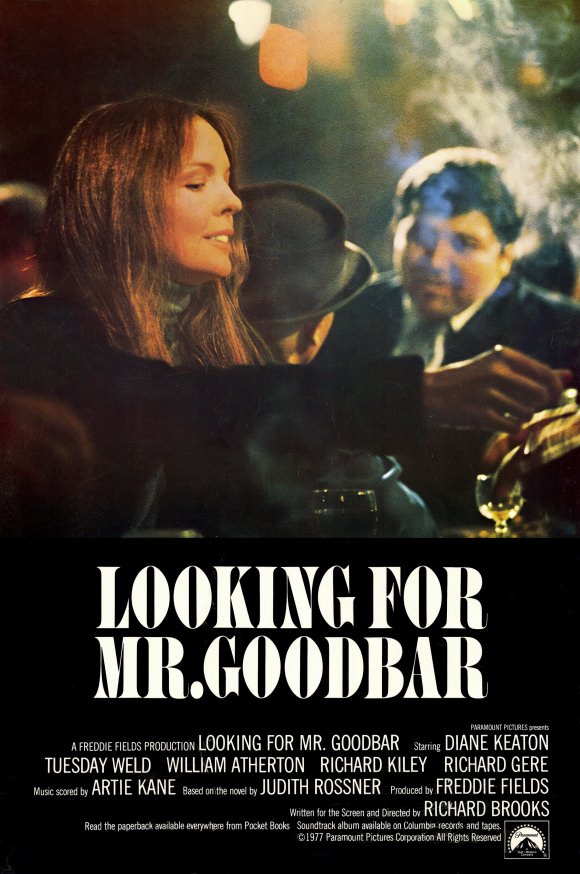
Looking for Mr. Goodbar (1977)


          A dark meditation on the Sexual Revolution that caroms wildly between sensitive vignettes and overwrought climaxes, Looking for Mr. Goodbar divided audiences during its original release but has since attained cult-movie notoriety, especially because, as of this writing, it has yet to be released on DVD or Blu-Ray. (Falling into obscurity often boosts a once-popular film’s reputation.) Adapted from a best-selling novel by Judith Rossner and written and directed by uncompromising auteur Richard Brooks, the movie is a cautionary tale, but it’s not entirely clear what Brooks wants to caution viewers against. Sometimes, it seems as if he’s castigating his lead character, a young professional woman with a wild sex life, for the sin of seeking physical fulfillment. At other times, it seems as if the villain of the piece is the lead character’s recklessness. And thanks to a gruesome narrative turn during the story’s third act, an implication is communicated that homosexuality is a malignant societal force. Suffice to say, the sexual politics of the movie have not aged well.
        Yet certain elements of the picture probably seemed damned weird right from the get-go—consider the awkward device of grown-up star Diane Keaton playing her character during college scenes, or such surrealistic flourishes as the trippy visual effect that’s featured during the final shots of the movie. In fact, Brooks takes a gonzo storytelling approach from start to finish simply by pitching the intensity level of key scenes absurdly high. Were it not for the supple textures of Keaton’s performance, Looking for Mr. Goodbar would feel like a cartoon, albeit a nihilistic one.
          The story follows Teresa (Keaton), a good girl from a religious New York City-area family, as she matures professionally and sexually. Following an eye-opening dalliance with her college professor, Teresa takes a job as a teacher at a school for deaf children, so right from the beginning of this young woman’s journey, her intellectual and physical lives are intertwined. Teresa’s older sister, Katherine (Tuesday Weld), is a high-strung swinger who gets in too deep with a sexually adventurous man, but instead of being frightened by Katherine’s experiences, Teresa is titillated.
          Soon, Teresa enters the swinger world and gets involved with men including Tony (Richard Gere), a small-time crook who introduces Teresa to cocaine. (One memorably campy scene features Tony, jacked up on blow, doing push-ups in Teresa’s apartment while wearing nothing but a jockstrap.) Teresa also becomes involved with James (William Atherton), a social worker who represents a “safe” choice of romantic partner. However, she shuns his old-fashioned normalcy in favor of freakier delights. Eventually, Teresa’s sexual wanderlust lands her in bed with Gary (Tom Berenger), a sexually confused young man with a prison record, which instigates the movie’s infamous final scene.
          Looking for Mr. Goodbar is strange on many levels, but the most noteworthy cinematic disharmony is the rift between the story Brooks is telling and the one Keaton is telling. Brooks delivers every narrative assertion with an exclamation point, eschewing subtlety for hand-wringing histrionics. Meanwhile, Keaton does extraordinary work, imbuing her performance with naturalism and spontaneity. In essence, Brooks tries to make a Grand Statement while Keaton sketches a character study. This has the effect of making Keaton feel separate from the rest of the movie, especially when Gere over-acts his way through a ridiculous performance that Brooks should have restrained. And while supporting players including Atherton, Richard Kiley, and Priscilla Pointer all deliver competent work, the only actor who achieves the same level of nuance as Keaton is Weld, a perpetually underutilized daredevil of a performer who is capable of incandescence in the right context. (Her work in this movie earned a Best Supporting Actress Oscar nomination.) Ultimately, Looking for Mr. Goodbar is a uniquely disjointed movie—part melodrama, part tragedy, and part oh-so-’70s bummer phantasmagoria.

Looking for Mr. Goodbar: FREAKY