Showing posts with label diane keaton. Show all posts

Wednesday, August 21, 2013

Play It Again, Sam (1972)


          The romantic comedy Play It Again, Sam is significant for two very specific reasons: It’s one of only two ’70s movies that Woody Allen acted in but did not direct, and it’s the first screen collaboration between Allen and his definitive ’70s leading lady, Diane Keaton. Adapted by Allen from his own stage play of the same name and directed by the always-elegant Herbert Ross, Play It Again, Sam is a silly trifle about a nebbish who falls in love with his best friend’s wife while receiving advice from an imaginary version of movie icon Humphrey Bogart. The contrast between geeky little Allen and suave, trenchcoat-wearing Bogie (played by Jerry Lacy) is consistently amusing, and the chemistry between Allen and Keaton, who play simpatico neurotics, is terrific. So, even though the movie is never laugh-out-loud funny and even though the story gets overly mechanical toward the end, Play It Again, Samgoes down smoothly.
          Set in San Francisco, the picture stars Allen as Allan, a film critic whose wife, Nancy (Susan Anspach), just left him. Allan finds comfort in the company of his pal Dick (Tony Roberts), a self-involved businessman, and Dick’s amiable but high-strung wife, Linda (Keaton). As Dick and Linda try again and again to connect Allan with new women—most of the blind dates go disastrously bad—Allan daydreams that his favorite tough-guy movie star, Bogart, has materialized to offer romantic advice. This culminates in a complex scene of Allan putting the moves on Linda while arguing with Bogie, who pushes Allan to act more aggressively. Shtick ensues. Giving the sort of super-invested, almost desperate comic performance that marked his earliest films, Allen relies as much on physical slapstick as he does on his trademark wit—and while the trope of Allen bumping into walls and knocking over tables gets tired, his one-liners are great. (“I was incredible last night in bed—I never once had to look up and consult the manual.”)
          From a writing perspective, Allen does a great job of “opening up” the play, using cross-cutting and multiple locations to make the piece feel completely cinematic. Concurrently, Ross finds clever ways to slip the Bogart character into and out of scenes. It all basically works until the end, when Allen twists the story in knots so he can stage a riff on the final scene of Casablanca(1942). (The real thing appears during the opening scene of Play It Again, Sam, when Allan watches Casablanca In a theater.) This forced climax lacks the effortlessness that distinguishes the rest of the film, but it was probably the best means of paying off the whole Bogart angle. Flaws aside, Play It Again, Sam is quasi-essential viewing for ’70s-cinema fans, because a year after this picture was released, Allen and Keaton reteamed for Sleeper(1973), the first in the five Allen-directed ’70s movies they made together. In other words—and you knew this was coming, didn’t you?—Play It Again, Sam was the beginning of a beautiful friendship.

Play It Again, Sam: GROOVY

Friday, April 12, 2013

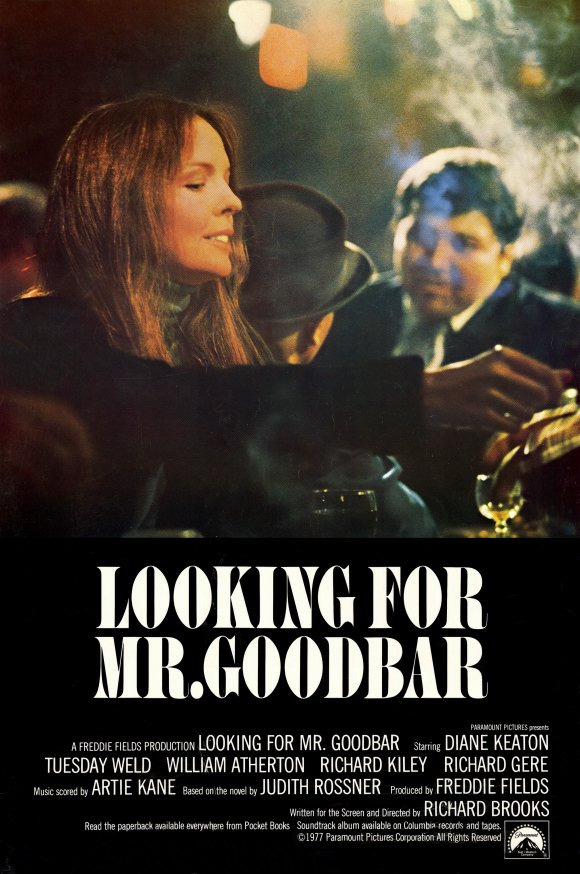
Looking for Mr. Goodbar (1977)


          A dark meditation on the Sexual Revolution that caroms wildly between sensitive vignettes and overwrought climaxes, Looking for Mr. Goodbar divided audiences during its original release but has since attained cult-movie notoriety, especially because, as of this writing, it has yet to be released on DVD or Blu-Ray. (Falling into obscurity often boosts a once-popular film’s reputation.) Adapted from a best-selling novel by Judith Rossner and written and directed by uncompromising auteur Richard Brooks, the movie is a cautionary tale, but it’s not entirely clear what Brooks wants to caution viewers against. Sometimes, it seems as if he’s castigating his lead character, a young professional woman with a wild sex life, for the sin of seeking physical fulfillment. At other times, it seems as if the villain of the piece is the lead character’s recklessness. And thanks to a gruesome narrative turn during the story’s third act, an implication is communicated that homosexuality is a malignant societal force. Suffice to say, the sexual politics of the movie have not aged well.
        Yet certain elements of the picture probably seemed damned weird right from the get-go—consider the awkward device of grown-up star Diane Keaton playing her character during college scenes, or such surrealistic flourishes as the trippy visual effect that’s featured during the final shots of the movie. In fact, Brooks takes a gonzo storytelling approach from start to finish simply by pitching the intensity level of key scenes absurdly high. Were it not for the supple textures of Keaton’s performance, Looking for Mr. Goodbar would feel like a cartoon, albeit a nihilistic one.
          The story follows Teresa (Keaton), a good girl from a religious New York City-area family, as she matures professionally and sexually. Following an eye-opening dalliance with her college professor, Teresa takes a job as a teacher at a school for deaf children, so right from the beginning of this young woman’s journey, her intellectual and physical lives are intertwined. Teresa’s older sister, Katherine (Tuesday Weld), is a high-strung swinger who gets in too deep with a sexually adventurous man, but instead of being frightened by Katherine’s experiences, Teresa is titillated.
          Soon, Teresa enters the swinger world and gets involved with men including Tony (Richard Gere), a small-time crook who introduces Teresa to cocaine. (One memorably campy scene features Tony, jacked up on blow, doing push-ups in Teresa’s apartment while wearing nothing but a jockstrap.) Teresa also becomes involved with James (William Atherton), a social worker who represents a “safe” choice of romantic partner. However, she shuns his old-fashioned normalcy in favor of freakier delights. Eventually, Teresa’s sexual wanderlust lands her in bed with Gary (Tom Berenger), a sexually confused young man with a prison record, which instigates the movie’s infamous final scene.
          Looking for Mr. Goodbar is strange on many levels, but the most noteworthy cinematic disharmony is the rift between the story Brooks is telling and the one Keaton is telling. Brooks delivers every narrative assertion with an exclamation point, eschewing subtlety for hand-wringing histrionics. Meanwhile, Keaton does extraordinary work, imbuing her performance with naturalism and spontaneity. In essence, Brooks tries to make a Grand Statement while Keaton sketches a character study. This has the effect of making Keaton feel separate from the rest of the movie, especially when Gere over-acts his way through a ridiculous performance that Brooks should have restrained. And while supporting players including Atherton, Richard Kiley, and Priscilla Pointer all deliver competent work, the only actor who achieves the same level of nuance as Keaton is Weld, a perpetually underutilized daredevil of a performer who is capable of incandescence in the right context. (Her work in this movie earned a Best Supporting Actress Oscar nomination.) Ultimately, Looking for Mr. Goodbar is a uniquely disjointed movie—part melodrama, part tragedy, and part oh-so-’70s bummer phantasmagoria.

Looking for Mr. Goodbar: FREAKY

Tuesday, January 1, 2013

Bananas (1971) & Sleeper (1973) & Love and Death (1975)


          Comedian-turned-filmmaker Woody Allen’s first full-fledged directorial effort was the lighthearted crime satire Take the Money and Run (1969), which underwent massive surgery during postproduction but ended up being brisk, charming, and funny—a learning experience for Allen, an enjoyable viewing experience for everyone else. Entering the ’70s, Allen demonstrated smoother filmmaking skills with Bananas, a farce set amid civil unrest in Latin America. Allen plays the wonderfully named Fielding Mellish, a New York City putz desperate to get political activist Nancy (Louise Lasser) into bed. Trying to impress her, Fielding travels to the fictional country of San Marcos and inadvertently joins a band of local revolutionaries. (The sequence of Fielding training to become a machine-gun-toting guerilla is a high point of early Allen slapstick.) Eventually, through farcical circumstances, Fielding becomes the Castro-like leader of the revolutionaries—resulting in the hilarious sight of Allen sporting a giant, Castro-esque beard tinted to match Allen’s red hair. Bananas climaxes with a riotous courtroom scene in which Fielding is tried for his un-American activities. (As one borough-bred accuser says, “He’s a bad apple! A commie! A New York, Jewish, intellectual, communist crackpot! I mean, I don’t wanna cast no aspersions.”) Lasser makes a terrific foil for Allen, and the movie benefits greatly from brevity, since it’s only 82 minutes—so, while Bananas is very silly, it’s also very amusing. And with the success of Bananas, the cycle of what later came to be termed Allen’s “early, funny ones” (the goofy comedies he made before tackling serious subject matter at the end of the ’70s) was underway.
          After a busy 1972, during which Allen starred in but did not direct the adaptation of his stage play Play It Again, Sam, which was his first movie with Diane Keaton—and made his only sketch movie, Everything You Always Wanted to Know About Sex* (*But Were Afraid to Ask), which was adapted from a popular nonfiction book—Allen returned to Bananasmode with the sci-fi comedy Sleeper. Once again placing a comically exaggerated version of his neurotic self into an outrageous circumstance, Allen plays Miles Monroe, the proprietor of a New York City health-food store. Accidentally thrown into suspended animation for 200 years, Miles awakes in a future America controlled by an Orwellian government. Quickly realizing he’s a target in this strange world, Miles disguises himself as a servant robot and hides in the household of Luna Schlosser (Keaton), thus commencing a gleefully convoluted plot involving conspiracies, spies, and, of course, the Orgasmatron. Allen pushes his slapstick almost to the breaking point here; at one point, he dons a giant, inflatable suit that carries him off into the sky. Yet some of the movie’s verbal interplay is memorably deft, and the chemistry between Allen and Keaton is fantastic—she probably his best-ever scene partner for pure comedy. As with Bananas, however, Sleeper suffers for a lack of substance, even though the jokes are solid. In fact, for some fans, Sleeper represents the apex of Allen’s breakthrough period.
          The last of Allen’s “early, funny ones” was the offbeat Love and Death, which mined humor from the unlikely source of classic Russian literature. Riffing on the novels of Dostoyevsky, Tolstoy, and others—the definition of dense, depressing fiction—Allen puts his patented New York schmuck character into the most outrageous setting yet. Wearing his signature horn-rimmed glasses, a running anachronistic joke since the movie takes place in the early 19th century, Allen plays Boris Grushenko, a coward (of course) who half-heartedly joins the Russian Army during the battle against Napoleon, and then becomes an unlikely hero. While the fish-out-of-water formula was getting a little thin by this point, Love and Death boasts Allen’s most sophisticated writing to date—how could it not, given the lofty subject matter?—and another winning collaboration with Keaton. Furthermore, Love and Deathprovides hints of the serious-minded artistry Allen would soon explore. The movie is laced with shout-outs to Bergman movies and silent Russian cinema, which are juxtaposed with cheerfully dumb sight gags. Clearly, Allen was itching to make something more meaningful than another pure joke machine, and with his next movie, 1977’s Annie Hall, he transformed the whole notion of a “Woody Allen film” into something complex, daring, and exciting.

Bananas: GROOVY
Sleeper: GROOVY
Love and Death: GROOVY

Monday, August 13, 2012

Manhattan (1979)


          Woody Allen’s most impassioned movie—if one accepts the popular notion that the great love of the comedian’s life is New York City, not any of his children or romantic companions—Manhattan is intoxicating from an aesthetic perspective. Allen’s genius notion of pairing George Gershwin’s resplendent music with artful black-and-white images of New York City turns every exterior shot into a cinematic postcard, and the way Allen stages an elaborate dance of interconnected romantic relationships against this magical backdrop accentuates the appealing idea that Manhattan is made for lovers. Yet the film is also challenging and complex, a hyper-literate saga starring Allen as a character for whom it’s difficult to sympathize.
          By the filmmaker’s own admission, Manhattan synthesizes elements from his two immediately preceding pictures, the bittersweet romance Annie Hall (1977) and the bleak family story Interiors (1978). Thus, Manhattan’s blend of farce and pathos arguably represents Allen’s first truly mature work, a human story that neither hides behind crowd-pleasing jokes nor indulges in pretentious psychodrama. Manhattan is not for every taste, to be sure, but it’s a fascinating film made with exceptional intelligence and skill. Plus, even if the characters are painfully neurotic and self-serving, that’s at least partially the point—building on the sharply observed character work in Annie Hall, Allen used Manhattan to further hone his skills for cultural observation and social satire, and none of the film’s characters (including the Allen-esque scribe whom the director portrays) escapes devastating scrutiny.
          The main plot concerns the romantic travails of Isaac Davis (Allen), a comedy writer who is sleeping with a 17-year-old student (Mariel Hemingway). Despite this entanglement, Isaac is also drawn to a woman his own age (Diane Keaton), who is having an adulterous fling with Issac’s (married) best friend (Michael Murphy). Meanwhile, Isaac’s ex-wife (Meryl Streep), who came out as a lesbian after her marriage to Isaac ended, is writing a tell-all book about their relationship. Working once more with Annie Hall cowriter Marshall Brickman, Allen constantly jogs back and forth between comedy and drama, often in the same scene, and the film’s acidic dialogue explores the many ways people impede their own happiness.
          The central love story isn’t as compelling as that in Annie Hall—it’s hard to root for a grown man who’s schtupping a schoolgirl—and the movie sometimes skews a little too downbeat. However, the blazingly intelligent writing, the uniformly wonderful performances, and Gordon Willis’ spectacular cinematography make the film thoroughly rewarding. (Of special note among the actors is Hemingway, who gives the best performance of her career at a very young age; the curiosity, emotion, and naïveté she brings to her character almost makes Isaac’s inappropriate involvement understandable.) Most of all, it’s compelling to watch Allen’s artistry reach an early peak, and to realize that over the course of the ’70s, he rapidly evolved from a lightweight jokester to one of the world’s most important cinematic storytellers. 

Manhattan: RIGHT ON