Showing posts with label funky. Show all posts

Friday, August 30, 2013

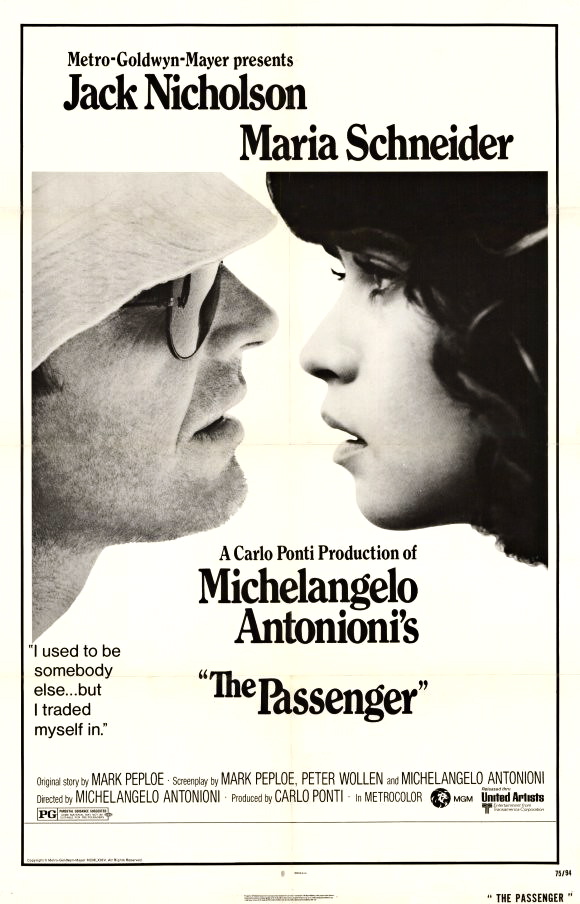
The Passenger (1975)


          Of the many negative effects that the emergence of the auteur theory had on the cinematic world, perhaps the most pernicious was the license that auterism gave some directors to indulge their inclinations toward pretentiously ambiguous filmmaking. Revered Italian director Michelangelo Antonioni offers ample evidence of this phenomenon in both this film and its predecessor, Zabriskie Point (1970). Although Antonioni broke through internationally with Blow-Up (1968), a tight thriller with subtle artistic flourishes, Zabriskie Point and The Passenger are opaque dramas more concerned with mood than narrative. Yet while Zabriskie Point is interesting for the way it captures certain attitudes of the counterculture generation, The Passenger has no such historical significance. Instead, it’s murky story about the grand themes of alienation, duplicity, and identity.
          Jack Nicholson, delivering one of the least interesting performances of his career, stars as David Locke, an American TV reporter tracking down story leads in equatorial Africa. Returning to his hotel one night, Locke discovers that a fellow traveler named Robertson has been murdered, so Locke steals Robertson’s papers, adds his photo in place of the dead man’s, and attempts to assume the Robertson’s identity. At first, this seems like a path to excitement, since Robertson was a gunrunner; Locke accepts payments from one of Robertson’s clients, and he also begins a romance with a sexy college student. (She’s played by Maria Schneider, of Last Tango in Paris fame, but Antonioni never bothers to give her character a name.) Eventually, Locke’s ruse unravels because he gets on the wrong side of dangerous men. There’s also a subplot involving Locke’s wife, who treks the globe looking for him. Everything culminates in a quasi-famous finale involving an elaborate tracking shot that, over the course of seven minutes, winds its way from a hotel room, into a courtyard, and back into the hotel room.
          Thanks to Antonioni’s refusal to provide explanatory details about characters and scenes—to say nothing of his painfully slow pacing—The Passenger is the sort of thing critics can spend decades dissecting, which means that many intelligent people have provided viable interpretations of the picture. Consumed as straightforward narrative, however, the film is borderline interminable. Countless insignificant actions are allowed to unfold at excruciating length, as if Antonioni hid meanings within the frame that the viewer is supposed to discover. Furthermore, because The Passenger features a distinct storyline, the movie weirdly straddles two worlds—it’s neither purely artistic nor purely narrative. Ultimately, the film is a bit like an abstract painting executed in a simplistic style: Where some beholders perceive layers, others see only the bland surface.

The Passenger: FUNKY

Thursday, August 29, 2013

Trilogy of Terror (1975)


          In honor of the recent passing of ’70s stalwart Karen Black . . . Fondly remembered by many fans as the TV movie in which Karen Black plays a woman who is menaced in her apartment by a tiny doll that attacks her with a miniature spear, Trilogy of Terror is a fairly pedestrian anthology of stories that sprang from the pen of prolific fantasist Richard Matheson. The author of countless memorable stories—from I Am Legend(originally published as a novel in 1953) to “Nightmare at 20,000 Feet,” the 1963 Twilight Zone episode in which William Shatner plays an airplane passenger who sees a gremlin on the plane’s wing—Matheson was a master at contriving frightening situations. And while none of the stories in Trilogy of Terrorrepresent the author’s best work, since all three are predicated on hokey contrivances, each component of Trilogy of Terror is somewhat droll. The problem, however, is that producer/director Dan Curtis (of Dark Shadows fame) shoots each story in such a stripped-down fashion that there’s not much in the way of atmosphere. The camerawork is bland, the lighting is flat, and the sets are sparse, so the only time Trilogy of Terror kicks into gear is at the end, when that nasty little doll goes on his rampage.
          Another dubious aspect of Trilogy of Terror is that it’s presented as a tour de force vehicle for leading lady Black, who stars in all three mini-movies. A unique screen personality with an eccentric brand of sex appeal, Black was usually best in small doses, and this project pushes her talent way past its limits. Still, she’s committed and energetic from start to finish. (Supporting actors include Robert Burton, George Gaynes, and Kathryn Reynolds, although this project’s all about Black’s multiple performances.)
          The first story, “Julie,” stars Black as a mousy college professor who is drugged and violated by one of her male students; her attacker, however, soon realizes he messed with the wrong woman. The second story, “Millicent and Therese,” is a clunker about two dueling sisters whose battle hides a not-very-surprising secret. The last story, “Amelia,” is the one about the doll. Black plays a woman who buys an African ritual doll that is rumored to contain the soul of a savage warrior. When she accidentally “activates” the doll, it chases her around the apartment, biting and stabbing her as she tries to fight back with closet doors, suitcases, and an oven. The last 15 minutes of Trilogy of Terror are so enjoyable that they (more or less) justify watching the entire brief movie, although none could be blamed for fast-forwarding straight to “Amelia.” The doll sequence has lost some of its ability to shock because the special effects are so primitive, but “Amelia” is still a nasty piece of business, and the final shot is truly haunting.

Trilogy of Terror: FUNKY

Wednesday, August 28, 2013

Ginger in the Morning (1974)


The early ’70s were rotten with low-budget dramas about middle-aged men hooking up with hippie chicks, because the prospect of exploiting counterculture “free love” attitudes for quick no-strings nookie seemed like an evergreen premise for lurid stories. Among the least distinguished entries in this mini-genre is Ginger in the Morning, the only noteworthy aspect of which is an early performance by Sissy Spacek. (Ginger in the Morningwas released between the actress’ early breakout in 1973’s Badlands and her star-making role in 1975’s Carrie.) Spacek is, by far, the best thing about this shoddy flick, demonstrating dignity and poise while playing a free-spirited Southern girl—and thereby neutralizing the potentially exploitive nature of the storyline. Whereas many similar films end up feeling slightly pornographic, with their wink-wink scenes of mature men seducing innocent hotties, this picture flips the premise simply by virtue of Spacek’s gravitas. Her character seems formidable right from the beginning, even if her flower-power belief system leads her to see more potential for good in people than she should. The nominal star of the picture is prolific B-movie/TV actor Monte Markham, a preening he-man who tends to arch his eyebrows for dramatic effect on nearly every line of dialogue. He plays Joe, a recently divorced man traveling through the Southwest after a business trip. Joe picks up hitchhiker Ginger (Spacek) and treats her like a gentleman throughout a day of driving—until he senses she’s game for a tumble. Taking her home to his pad in Santa Fe, Joe prepares to score until his best friend, Charlie (Mark Miller), shows up unexpectedly. Ginger overhears Joe telling Charlie that all Joe wants from Ginger is sex, so she gets affronted. Also thrown into the mix is Charlie’s estranged wife, Sugar (Susan Oliver). As a result, much of the movie comprises intercut melodrama as the two couples work through their issues. The scenes with Spacek are generally watchable because she acts with such sincerity, but everything else in the movie is a drag. The production values are cheap, the lighting is ugly, and the acting by Markham, Miller, and Oliver is, at best, ordinary. As for the story, it never rises above superficial and trite.

Ginger in the Morning: FUNKY

Saturday, August 24, 2013

Black Beauty (1971)


          Seeing as how the classic Anna Sewell novel Black Beauty (1877) is told from the perspective of a horse as it changes hands through various owners during its tumultuous lifetime, any film adaptation of the material faces some built-in problems. This 1971 version of the tale, for instance, portrays valiant steed Black Beauty as a sort of metaphor for goodness and innocence, using the behavior of people toward the animal to communicate Sewell’s themes. And while the absence of hokey anthropomorphization is to be applauded, the lack of a real personality for the leading character is a difficult problem for any film to surmount. Accordingly, the 1971 Black Beauty is a respectable endeavor thanks to crisp cinematography and impressive production values, but the picture doesn’t generate much emotional heat. Still, only the most hard-hearted viewer could fail to be touched in some small way by the travails of a noble animal that occasionally falls into the hands of horrific people.
          Set in Victorian England, the picture begins when Black Beauty is born on a rural farm. Witnessing the event is angelic child Joe (Mark Lester), the son of a poor tenant farmer who promises the newborn stallion to Joe as a pet. Joe raises the animal with great care and affection. Yet by the time Black Beauty is a young adult, the farm’s kindly owner has died and bequeathed his estate to a rotten son named Sam (Patrick Mower). Sam seizes the animal, beginning a long series of ownership transfers, some of which are to kind owners and some of which are to abusive ones. Eventually, Beauty becomes the property of characters including a circus owner (Walter Slezak), a principled soldier (Peter Lee Lawrence), and others. Some sequences are brisk and purposeful, like the nasty interlude during which Sam owns and mistreats Black Beauty, whereas others meander, particularly the long circus episode. The transitions between vignettes are not particularly graceful, because on some occasions Black Beauty simply stands in an empty field after being abandoned by one owner until someone else comes along to claim the horse and continue the story.
          Furthermore, it’s awkward that Black Beauty’s most important owner, young Joe, is portrayed via billing and posters as a main character when in fact he’s out of the movie rather quickly. (On the plus side, Lester—the star of the 1968 smash Oliver!—is a vapid performer who contributes very little to the movie’s appeal, so his absence is appreciated.) Aside from the inherent decency of the story and the undeniable grandeur of beautiful horses, the only exemplary element of Black Beauty is the cinematography by Chris Menges. His images are clean and spare, reflecting a singularity of aesthetic vision the film does not possess on any other level. FYI, director James Hill made a number of animal-themed pictures throughout his career, including the charming hit Born Free (1966) and such follow-ups as An Elephant Called Slowly (1970).

Black Beauty: FUNKY

Friday, August 23, 2013

Joe (1970)


          Capturing the anger and confusion of a historical moment when the “generation gap” was at its widest—the dawn of the 1970s—Joeis an unquestionably powerful film. That doesn’t necessarily mean it’s a goodfilm. The narrative is awkward and contrived, the title character doesn’t make his entrance until the 27-minute mark, and the infamous ending is predicated on a silly plot twist. So to characterize Joe as an incendiary statement would be to overreach considerably. Nonetheless, there are good reasons why the picture enjoyed substantial box-office success during its original release, and why it has retained some degree of notoriety since then. Written by Norman Wexler, Joe is about a middle-aged New York ad executive named Bill Compton (Dennis Patrick), who has become estranged from his twentysomething daughter, Melissa (played by Susan Sarandon in her debut film appearance).
          Living with a drug dealer in a grimy Greenwich Village flat, Melissa is a counterculture idealist who’s gotten dragged into her boyfriend’s dangerous world. When Melissa ends up hospitalized after an overdose, Bill tracks down and kills the boyfriend. Rattled after the crime, Bill stumbles into a dive bar where Joe Curran (Peter Boyle) is giving a drunken monologue blaming all of society’s problems on hippies and minorities (“Forty-two percent of all liberals are queer, that’s a fact!”). In one of the film’s least believable moments, Bill confesses his crime to Joe. Thus begins an unlikely odyssey during which Joe leverages the dirt he’s got on his new “friend” to force his way into Bill’s rarified world. Later, when Melissa flees from the hospital, Bill and Joe search for her in the drug underworld, a quest that culminates in an orgy where compliant hippie chicks service Bill and Joe while the ladies’ longhair boyfriends steal personal items from the “straights.” Revenge follows, as does tragic irony.
          As directed by the capable John G. Avildsen, who found tremendous success a few years later with Rocky (1976), Joe is probably a better-made film than the sketchy storyline deserves. The acting is uniformly good, with Boyle the obvious standout as a lout given license by circumstance to manifest his latent psychosis, and Avildsen does a fine job of defining spaces, from the crisp perfection of Bill’s Central Park apartment to the dirty chaos of hippie flophouses. But the story simply doesn’t work as anything except cheap provocation. It’s never totally clear what Joe wants from Bill, or why Bill tolerates Joe’s threatening proximity, and the idea that these two men eventually form true friendship stretches credibility to the breaking point. Worse, the Melissa character exists merely as a set-up for the ending, which doesn’t resonate anywhere near as strongly as the filmmakers presumably hoped it might have.

Joe: FUNKY

Monday, August 19, 2013

The Brothers O’Toole (1973)


          Near as I can tell, TV funnyman John Astin—best known as debonair but insane Gomez Addams on the ’60s sitcom The Addams Family—only received top billing in two theatrical features, including this bland comic Western and 1972’s Wacky Taxi. (He also starred in another comic Western, 1972’s Evil Roy Slade, but that project was actually made for television.) With his enjoyable slow-burn tantrums and his nimble way of delivering complex dialogue, Astin is by far the best thing about The Brothers O’Toole, which is bogged down by mechanical plotting, substandard production values, and vapid supporting performances. Representing a convergence of clichés, the plot begins when con man Michael O’Toole (Astin) finds himself lost in the desert after a scheme goes wrong. Eventually, Michael tracks down his idiot brother, Timothy O’Toole (Steve Carlson), before entering the frontier town of Molybdenum, Colorado. (As an example of how far the movie reaches for jokes, several flaccid attempts are made to wring humor from the mispronunciation of the town’s name as “Molly Be Damned.”) Michael gets thrown in jail after being mistaken by local authorities for a criminal named Desperate Ambrose. Timothy, wrongly assuming the incarceration is part of a scam Michael is running on the locals, “plays along” while getting into mischief of his own.
          All of this becomes very tedious, with a love story, a subplot about the discovery of gold, and the supposedly hi-larious antics of small-town kooks thrown in to spruce up the storyline. In the same way that Michael is kept behind bars for most of the movie, the filmmakers restrain their strongest asset, leading man Astin. He’s charming and funny and smart whenever the filmmakers remember to utilize him, but the movie loses all its energy whenever he’s off screen. At the picture’s nadir, Timothy enters the town’s “Spitting, Belching and Cussin’ Contest,” which should be an outrageous highlight but instead merely comprises a limp montage of people expectorating. The only redeeming element of this dull sequence is a speech that Michael delivers afterward, reprimanding the crass people of Molybdenum: He describes the town as “a festering pustule on the face of the Western slope.” One of only two features directed by veteran character actor Richard Erdman, The Brothers O’Tooleis amateurish on nearly every level, and the cast is peppered with B-listers who deliver perfunctory work. (For instance, onetime Miss America Lee Meriwether has a dreary extended cameo as Desperate Ambrose’s girlfriend.) Still, Astin fans will find much to enjoy in his performance, since Michael O’Toole exists outside the campy realm the actor usually occupies.

The Brothers O’Toole: FUNKY

Saturday, August 17, 2013

Goin’ South (1979)


          Having been exposed to the image countless times during my years as a video-store drone, since it was replicated on the movie’s VHS sleeve, the poster shot for Goin’ South has always irked me. At first glance, it’s a striking shot of star Jack Nicholson smiling wickedly while his face is framed by a noose. Upon close inspection, however, it’s clear that Nicholson is holding the noose in place to achieve the effect. The intended illusion is thus made and dispelled simultaneously. And so it goes for the movie itself, because throughout Goin’ South, Nicholson’s techniques as actor and director are so apparent that the movie feels laborious when it should feel effortless. After all, Goin’ South is supposed to be a comedy—and a romantic comedy, no less.
          Set in Texas during the Wild West era, the picture stars Nicholson as Henry Moon, an excitable but not particularly bright outlaw. Captured by lawmen including Sheriff Kyle (Richard Bradford) and Deputy Towfield (Christopher Lloyd), Moon is strung up for hanging. However, thanks to an arcane law allowing unmarried women to save condemned men by agreeing to marry them, young landowner Julie Tate (Mary Steenbugen) becomes Moon’s bride. Having inherited a ranch from her father, she needs a man and likes the idea of being able to use Moon for a slave since he owes her his life.
          Even though it’s rather convoluted, this premise could easily have generated an opposites-attract farce. Unfortunately, nearly every element in Goin’ Southmisses the mark. The screenplay meanders through dull and repetitive scenes. Supporting characters lack dimension. Plot twists emerge arbitrarily as opposed to organically. Nicholson’s direction is fuzzy, so scenes lack internal rhythm and the tone of the piece wobbles between broad comedy and subtle satire. Worst of all, the performances are terribly out of sync with each other. Steenburgen, appearing in her first movie, mostly communicates gentle nuances, while Nicholson goes way, way over the top.
          In fact, it’s probably fair to describe the actor’s work in Goin’ South as some of the worst acting in his career. Whether he’s frowning with an open mouth to imply stupidity or widening his eyes to indicate lunacy, Nicholson is silly and tiresome in nearly every scene; virtually the only clever touch he employs is speaking at various intervals with a phlegmatic knot in his voice, suggesting a character for whom language does not come easily. And to say the leads lack chemistry is a huge understatement. It’s also irritating to see two potent comic actors—John Belushi (another actor making his big-screen debut in Goin’ South) and Danny DeVito—relegated to insignificant supporting roles. Really the only member of the Goin’ South gang whose work is consistently praiseworthy is cinematographer Nestor Almendros, who paints most scenes with an appealing golden glow.

Goin’ South: FUNKY

Friday, August 16, 2013

They Might Be Giants (1971)


The whimsical romantic adventure movie They Might Be Giants, adapted by James Goldman from his play of the same name and directed by Anthony Harvey, has more heart and novelty than it has credibility and resolution. Nonetheless, the piece communicates such a lovely theme that it’s possible to overlook many shortcomings. Similar in many ways to a more satisfying movie that came along 20 years later—The Fisher King (1991), with Jeff Bridges and Robin Williams—They Might Be Giants asks whether society can tolerate harmless kooks, particularly if they envision themselves as heroes striving for the common good. However, Goldman doesn’t come close to answering the biggest questions his story raises, instead employing cutesy literary sidesteps to avoid thorny issues. Still, the journey of the movie is unique, and the picture is energized by lively performances. Furthermore, while Goldman and Harvey never approach the heights of their previous screen collaboration—the acclaimed historical drama The Lion in Winter (1968)—their approach is consistently literate and sophisticated. Set in contemporary New York, the picture revolves around Justin Playfair (George C. Scott), a wealthy retired judge who slipped into fantasy after the death of his wife. Imagining himself to be Sherlock Holmes and even going to the extreme of strutting around in 19th-century dress, Justin is admitted to a mental hospital by scheming relatives and placed under the care of psychiatrist Dr. Mildred Watson (Joanne Woodward). And, yes, the gimmick of this movie’s “Holmes” finding his own personal Dr. Watson is just as extravagant a narrative indulgence as it sounds. Against a backdrop of Justin’s relatives angling to get him permanently committed so they can seize control of his money, Justin escapes the hospital and embarks on a quest to find the nefarious Dr. Moriarity—who, in the world of this story, doesn’t exist. Justin’s grand quest inspires acquaintances including Wilbur Peabody (Jack Gilford), a milquetoast senior who harbors heroic fantasies of his own, and Justin’s offbeat brilliance eventually sparks romance with Mildred. The movie vamps on its premise quite a bit, since the story can’t really go anywhere, but Scott is so commanding and Woodward is so stalwart that it’s a pleasure to watch them share the screen as their respective characters. After all, what’s not to like about the spectacle of two insightful people pooling their resources to right the wrongs of the world? (Gilford lends tenderness to the mix with his unassuming likeability.) One wishes there was as much substance in They Might Be Giants as there is style, since the specifics of the story disappear from memory rather quickly after watching the movie. But for viewers seeking a flamboyant lark, They Might Be Giants fits the bill.

They Might Be Giants: FUNKY

Thursday, August 15, 2013

Drive-In (1976)


          Given the mixture of silly and sublime pleasures one could enjoy at the neighborhood drive-in theater in the heyday of that particular exhibition format, there was probably a great—or at least highly entertaining—movie to be made about the misadventures of teenagers during one eventful night at a Texas drive-in. Sadly, Drive-In is not that movie, although the picture’s quite harmless as a nostalgia piece. The reason the flick disappoints is that it tries to be a sex comedy but lacks any scandalous content, and that it tries to present an interwoven ensemble story but fails to present sufficiently dynamic characters to sustain interest. As portrayed by a group of no-name actors whose skill levels range from competent to nonexistent, the characters in Drive-In are mostly just clichéd rednecks, with such familiar types as the virginal good guy, the town slut (with a heart of gold), the smartass fat kid, and the mouth-breathing troublemaker on display. Nearly every beat of the movie is predictable, and the comic highlights—the waterbed in a swinger’s van gets knifed by an angry woman, would-be robbers get recognized by a neighbor while committing a crime—are tepid at best.
          The principal storyline involves gangly high-school redhead Orville (Glenn Morshower, who later became a fine character actor) inadvertently wooing raven-haired sexpot Glowie (Lisa Lemole) away from her violent boyfriend, Enoch (Billy Miliken). This romantic triangle culminates in a fistfight at the drive-in. Meanwhile, two local yokels attempt to rob the theater’s box office, but their would-be crime is married by bad lack and incompetence. Sprinkled between these storylines are goofy subplots such as the running gag of a drunken cowboy suffering through a night on the town with his overbearing mother. The only clever element of Drive-In is the movie within the movie, which is displayed onscreen at the main location. Disaster ’76 is an amusing spoof of the disaster genre, so every time a new scene is shown, Disaster ’76 incorporates another epic hardship—plane malfunctions, shark-infested waters, towering infernos, etc. Getting back to the overall movie, Drive-Infeatures such fondly remembered tropes as people sneaking into the theater by hiding in car trunks, and the temporary suspension of the feature attraction during a brief rainstorm. As such, Drive-Indoes an okay job of capturing a social ritual that’s largely disappeared from the American experience.

Drive-In: FUNKY

Friday, August 9, 2013

Kotch (1971)


          Walter Matthau delivered a series of wonderfully entertaining performances in the ’70s, his rapscallion charm stemming from the ability to hide characters’ warmhearted souls behind a disagreeable persona. For much of the decade, watching Matthau play men who bitch and whine their way toward doing the right thing was a source of endless pleasure. To his credit, however, Matthau wasn’t averse to deviating from his signature style. For instance, Matthau took something of a leap with Kotch by playing not only an overtly nice character but also by playing a senior; after all, the actor was merely middle-aged at the time of filming. And while Matthau scored an Academy Award nomination for his trouble (eventually losing Best Actor to Gene Hackman’s star-making turn in The French Connection), one would be hard-pressed to describe Kotch as a seminal Matthau project. Kotch is forgettable and sentimental, so the picture’s only real claim to fame is that it was the only feature directed by actor Jack Lemmon, Matthau’s frequent onscreen sparring partner. Lemmon’s filmmaking seems competent, though it’s hard to tell how much of the picture’s craftsmanship sprang from Lemmon’s imagination and how much was the result of solid work by Lemmon’s experienced crew. The shortcomings of Kotch are not related to execution. Rather, they stems from the underlying material, because the story—which screenwriter John Paxton adapted from a novel by Katharine Topkins—simply isn’t very interesting.
          The movie’s narrative concerns Joseph Kotcher, a likeable old man living with his son’s family. “Kotch” is enamored of his very young grandson, Duncan, but Kotch’s daughter-in-law wants the old man relocated to a retirement home. In the film’s most poignant sequence, Kotch realizes he’s not wanted, so he hits the road in order to find a new living arrangement. Not long afterward, the film settles into a sitcom-style dynamic: Kotch befriends Erica (Deborah Winters), a young pregnant woman. Although the film avoids any suggestion of May-December romance, the relationship is predictable—Kotch needs someone to nurture, Erica needs a guardian, blah-blah-blah. (It’s also distracting that the still-vital Matthau spends the whole movie hidden behind glasses, old-age makeup, and a white wig.) Filmed with a lush glow and served on a bed of gooey music by Marvin Hamlisch, Kotch is pleasant enough to watch. Furthermore, it’s hard to criticize a story that celebrates compassion, tenderness, and the value of senior citizens. Alas, good intentions only go so far. Especially seeing as how bolder filmmakers working in the same era were able to generate such surprising senior-themed stories as Harry and Tonto(1974) and Going in Style (1979), the unthreatening narrative of Kotchseems bland beyond belief when compared those films. As a result, only Matthau’s innate charisma and the film’s upscale production values give Kotchany real distinction.

Kotch: FUNKY

Tuesday, August 6, 2013

The Little Prince (1974)


          Although I managed to pass through childhood without any exposure to the story, I’ve learned that French author/aviator Antoine de Saint-Exupéry’s fantastical novella The Little Prince is one of the most successful and widely read children’s stories of the 20th century. I mention this by way of stating that I approached this film adaptation without any feelings toward the source material, so others can hold forth on whether the picture does justice to de Saint-Exupéry’s writing. Watching the film of The Little Prince as its own entity, I found little to like despite the imaginative narrative and worthwhile themes. Director Stanley Donen, a giant of studio-era musical films whose career was winding down when he made The Little Prince, brings a fair amount of style in the form of clever fisheye-lens photography and general exuberance, but the combination of coldly professional acting by the leading players and distractingly artificial settings for many scenes makes the piece feel perfunctory rather than passionate.
          It’s also not a good sign that when famed choreographer-director Bob Fosse shows up in a rare acting role, he completely takes over the film for several minutes with his signature brand of cinematic and physical movement; although merely credited as choreographer for his own sequence, Fosse likely had a hand in the design of camera shots and editing, as well, and his bit is the liveliest stretch of the movie.
          Anyway, the story of The Little Prince must lose something in translation, because as presented onscreen, it’s insipid. When a character known only as the Pilot (Richard Kiley) lands his plane in the Sahara after experiencing engine trouble, he meets a strange young boy, the Little Prince (Steven Warner), who claims to have come from an asteroid in outer space. The Little Prince regales the Pilot with tales of his encounters with strange characters, including a friendly Fox (Gene Wilder), a demanding Rose (Donna McKechnie), and a pernicious Snake (Fosse). Each encounter taught the Little Prince a lesson, and so does his friendship with the Pilot.
          As communicated through twee songs by the famed duo of Alan Jay Lerner (who also wrote the screenplay) and Frederick Loewe (who also composed the score), the Little Prince’s adventure says something about the importance of retaining a child’s innocence even in adult life. Yet while the content is admirable, the execution is blah. Exterior daytime scenes in the desert are visually dull, nighttime exterior scenes shot on a soundstage are phony-looking, and the tricks Donen uses to simulate outer-space environments are gimmicky. Yet it’s ultimately the performances that keep The Little Princefrom achieving liftoff. Kiley, a lovely actor with a resonant voice, is too theatrical, and young Steven Warner comes across as an automaton doing what he’s told. So, even with Fosse’s dynamic dance sequence and Wilder’s touchy-feely extended cameo, there’s little heart in what should be a deeply moving parable.

The Little Prince: FUNKY

Friday, August 2, 2013

Fighting Mad (1976)


          Filmmaker Jonathan Demme completed his productive tenure in Roger Corman’s B-movie operation with this uneven but watchable action picture about a principled redneck standing up to greedy developers. There’s nothing even slightly original about the plot, but as writer and director, Demme fills the picture with just enough idiosyncratic flourishes to keep things interesting during the beginning and middle of the story. Then, during the climax, Demme unleashes an exciting nighttime showdown replete with not only gunplay but also, for novelty’s sake, death by bow and arrow. Peter Fonda (of course) stars as Tom Hunter, a young man who returns to his family’s home in Arkansas only to discover that every private landowner in the immediate vicinity is under pressure from operatives of real-estate mogul Pierce Crabtree (Philip Carey). Crabtree wants to raze low-income homes to make way for a shopping mall, and he won’t take no for an answer, so his goons use lethal force to frighten citizens into selling. Among those who fall victim to Crabtree’s thugs are Tom’s brother, Charlie (Scott Glenn), and his wife. This pushes Tom into ass-kicking mode. Meanwhile, Tom manages his relationships with his young son, Dylan (Gina Franco); his on-again/off-again girlfriend, Lorene (Lynn Lowry); and his salt-of-the-earth father, Jeff (John Doucette), whose property is in Crabtree’s crosshairs.
          The best parts of Fighting Mad feature Tom sticking it to the man, because the tension between Fonda’s laconic persona and his character’s righteous passion is consistently interesting. The star is fun to watch whether he’s commandeering a tractor, planting explosives at a Crabtree work site, or shooting arrows into henchmen. Whenever the action hits a lull, however, so does the movie. Demme’s storytelling is choppy—every time it seems Fighting Mad has kicked into gear, Fonda’s character stops for a beer or a tumble with his girlfriend. Demme also lingers on pointless bits like musical performances, continuing his endearing/irritating career-long habit of losing the forest for the trees. Production values in Fighting Mad are fairly strong for a Corman production, since Demme focuses on real locations with loads of texture, and the performances get the job done; Doucette and Glenn in particular lend humanity to their small roles. However, the music score, by folk musician and frequent Fonda collaborator Bruce Langhorne, is all over the place—the old-timey bits with lots of banjo suit the milieu, while the electronic suspense stings hit their target but seem pulled from another movie.

Fighting Mad: FUNKY

Wednesday, July 31, 2013

The Out of Towners (1970)


          The Out of Towners is notable as the first feature that mega-successful playwright/screenwriter Simon wrote directly for the big screen; previously, the comedy kingpin adapted such hits as Barefoot in the Park (1967) and The Odd Couple(1968) from his own plays. The good news is that Simon has a blast taking advantage of opportunities presented by the cinematic medium, so The Out of Towners starts in Ohio, zooms to Boston, lands in New York, and covers dozens of locations. The bad news is that the piece isn’t especially funny—too often, frenetic activity substitutes for inspiration. That said, the premise is amusing, since the picture aims to depict the worst trip to New York any couple has ever experienced. This is Simon in pure-farce mode, not touchy-feely Simon.
          Jack Lemmon stars as George Kellerman, an Ohio businessman summoned to Manhattan for a job interview. While he and his wife, Gwen (Sandy Dennis), fly from Ohio to New York, George shares his grand, OCD-fueled plans for a night of dinner and dancing before acing the interview in the morning. However, Gwen’s enthusiasm is muted—she’s perfectly happy raising the couple’s kids in the Midwest. Then comes a series of calamities: New York gets fogged in, so the couple’s plane is rerouted to Boston; catching trains is a nightmare; New York is gripped by a transit strike; the Kellermans’ hotel reservation is cancelled; muggers prey on the couple; and so on. About half of the problems that Simon contrives represent clever satire, and about half represent narrative desperation. For instance, George’s stubborn insistence to remain inside a police car while the officers at the wheel chase criminals is an absurdly stupid decision. Only Lemmon’s innate likability ensures that George remains more or less palatable, and it helps that Lemmon is virtually peerless at playing frazzled schmucks. Sadly, Dennis can’t come close to matching her costar’s energy, coming across as bland and mousy until the latter half of the picture, when her character suddenly (and unbelievably) grows a spine.
          Compounding the inequity of the leading performance is director Arthur Hiller’s grubby camerawork. Although he paces scenes beautifully, Hiller shoots the picture with the dark, handheld textures of a crime movie; as does Quincy Jones’ weirdly intense score, the look of the film makes some scenes that should be humorous seem frightening. Ultimately, however, the real blame for the project’s overall mediocrity must fall on Simon, who sacrifices character reality for silly gags at regular intervals. Nonetheless, The Out of Towners gained enough stature to warrant a remake in 1999. In the second version of the story, Steve Martin and Goldie Hawn play the titular travelers.

The Out of Towners: FUNKY

Monday, July 29, 2013

Tales That Witness Madness (1973)


          UK-based Amicus Productions, a second-tier competitor to Hammer Films, earned a niche in the horror marketplace by making a series of anthology movies, nasty little numbers featuring terse vignettes grouped by framing stories. Examples include Tales from the Crypt (1972) and The Vault of Horror (1973). The success of these pictures inevitably led other companies to ape the Amicus formula, hence this silly project from World Film Services. Although Tales That Witness Madness is a respectable endeavor thanks to decent production values and the presence of familiar actors, the script by Jennifer Jayne (writing as Jay Fairbank) is an uninspired pastiche of hoary shock-fiction tropes. There’s not a genuine scare in Tales That Witness Madness, and most of the humor is of the unintentional sort. Plus, the longest story is almost interminably boring.
          The picture begins with a shrink, Dr. Tremayne (Donald Pleasance), showing a colleague around a psychiatric facility where four odd patients are housed. As each patient is presented, his or her tale appears in flashback. The first bit, “Mr. Tiger,” features a little boy whose bickering parents discover the lad’s imaginary friend may not be imaginary. Next comes “Penny Farthing,” a drab yarn about an antique dealer getting possessed by the figure in an old painting. In “Mel,” the best vignette of the batch, an artist (Michael Jayston) brings home an old tree and then decides he likes the tree better than his wife (Joan Collins). The final sequence, “Luau,” is a tedious tale about people caught up in a ritual-sacrifice scheme. Except for “Mel,” which has a pithy, Twilight Zone-esque tone, the stories drone on lifelessly. (“Mr. Tiger” is fine, but the “twist” ending is so obvious from the first frame that there’s no tension.)
          The actors all deliver serviceable work, with young Russell Lewis (as the boy in “Mr. Tiger”) and Jayston (the artist in “Mel”) providing the most vivid performances. As for the leading ladies, Collins, who inexplicably spent much of the ’70s appearing in bad horror movies, does her usual shrewish-sexpot routine, while Hollywood actress Kim Novak—playing the lead in “Luau”—drains all vitality from the movie with her colorless non-acting. Director Freddie Francis, the former cinematographer who directed numerous frightfests for Hammer and Amicus (including the aforementioned Tales from the Crypt, among other horror anthology movies), handles this project with his characteristic aplomb, but even his smooth style can only compensate so much for the enervated nature of the stories.

Tales That Witness Madness: FUNKY

Saturday, July 27, 2013

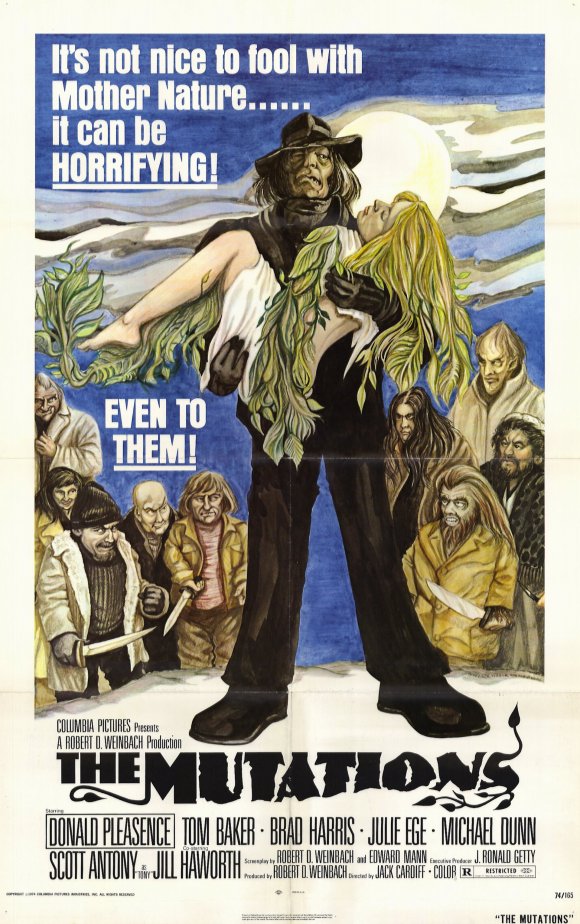
The Mutations (1974)


          Reflecting its storyline about a mad scientist who gene-splices people and plants to create monsters, this lurid UK flick offers two movies for the price of one. The putative main story is an unintentionally hilarious stinker, with Donald Pleasance phoning in his bad-guy performance while the film’s special-effects team delivers laughably bad monster costumes. However, a major subplot about the mad scientist’s deformed henchman has a certain degree of pathos and suspense, especially because the subplot borrows many elements from the 1932 cult classic Freaks. Set in modern-day England, The Mutations stars Pleasance as Professor Nolter, a psycho who envisions a new race of humans imbued with plant characteristics. Nolter’s accomplice is Lynch (Tom Baker), a deformed giant who abducts young men and women for Nolter to use as test subjects. Lynch is the leader of a group of circus freaks living at an amusement park, yet while the other circus performers are harmless, Lynch is a self-loathing psychotic. Thus, while Nolter tempts fate by taking his experiments too far, Lynch is driven to madness by waiting for Nolter to deliver on promises of correcting Lynch’s deformity. (The picture also features perfunctory material involving attractive students either investigating the disappearances of their classmates or becoming victims of Nolter’s weird science.)
          As helmed by Jack Cardiff, a master cinematographer who occasionally directed, The Mutations has a colorful look and one or two genuinely creepy scenes, notably the Freaks-influenced conclusion of Lynch’s storyline. The acting is generally bland, but Baker (beloved by many for his long run on the UK TV series Doctor Who) does well playing Lynch in the Vincent Price mode of a killer besieged by inner demons. The film’s other noteworthy performance comes from the diminutive Michael Dunn, familiar to American TV fans for his work as Dr. Loveless on the ’60s show The Wild Wild West. He plays the little person who represents the conscience of the circus-freak community. Furthermore, starlets including the scrumptious Julie Ege provide major eye candy while clothed and otherwise, and The Mutationsbenefits from an eerie music score that utilizes dissonant classical music—a truly unsettling flourish. FYI, The Mutations sometimes carries the alternate title The Freakmaker.

The Mutations: FUNKY

Thursday, July 25, 2013

Puzzle of a Downfall Child (1970)


          Based on its pedigree alone, the obscure drama Puzzle of a Downfall Child merits investigation by any fan of serious-minded ’70s cinema. The picture stars Faye Dunaway, it was directed by photographer-turned-filmmaker Jerry Schatzberg (whose other films include 1971’s The Panic in Needle Park and 1973’s Scarecrow), and Schatzberg co-wrote the script with Carole Eastman, whose other release in 1970 was the iconic Jack Nicholson drama Five Easy Pieces. (Eastman wrote Puzzleunder the pseudonym “Adrien Joyce.”) Beyond the big names involved in the project, Puzzle of a Downfall Childis noteworthy because of its heavy themes—abusive relationships, fame, drug addiction, mental illness. For those who like their ’70s movies anguished and artistic, this is quintessential stuff on many levels.
          Unfortunately, the storytelling of Puzzle of a Downfall Child is pretentious and vague. The narrative is presented in dreamlike fragments, often with psychobabble voiceover played over dissociated imagery, and the heart of the picture—as the overly precious title suggests—is a slow revelation of one disturbed woman’s psyche. Only the most masterful actors and filmmakers can make this sort of thing work, and neither Dunaway nor Schatzberg demonstrates that level of supreme artistic control. So, while Puzzle of a Downfall Child is a noble effort, it fails to generate much in the way of real emotion. Plus, quite frankly, at times it barely sustains interest.
          The film begins at an isolated beach house, where Lou (Dunaway) is sequestered while recovering from some mysterious personal crisis. Her only companion is a longtime friend, fashion photographer Aaron (Barry Primus), who interviews her because he’s planning to make a movie about Lou’s life. In flashbacks, we see Lou’s ascendance from the lowest ranks of modeling to the upper echelon; along the way, she gets involved with a series of inappropriate men, including the abusive Mark (Roy Scheider). Dunaway is in nearly every frame of this film, so there was an opportunity for her to give a tour-de-force performance. Alas, she plays the exterior of her role well, but that’s about it. In her defense, she’s burdened with an insufferably narcissistic characterization—Lou is one of those navel-gazing ’70s-cinema egotists whose every utterance explains why she’s dissatisfied with this or unhappy about that. Yet it’s clear why many people suffer her whining, because she’s an exquisite beauty who photographs extraordinarily well.
          In fact, one can’t help but get the impression Schatzberg fell under Dunaway’s spell the same way the film’s characters are bewitched by Lou. Schatzberg photographs Dunaway with delicate artistry, which hurts her performance by making the actress seem like she’s preening even when she’s supposed to be unglamorous. (Dunaway and Schatzberg were engaged around the time they made this picture, though they never married.)
          Puzzle of a Downfall Child also suffers for a lack of closure, since the “puzzle” of the title is never solved in a satisfactory way—viewers eventually learn that Lou fell into narcotics and suffered a nervous breakdown, but even after listening to the character prattle on about herself for 105 minutes, she remains an enigma. Nonetheless, Schatzberg’s pictorial style is elegant, and supporting actors lend varied colors. Viveca Lindfords flounces through the film as a grandiose photographer, while Primus channels the anguish of unrequited love and Scheider provides the movie’s irredeemable-asshole quotient.

Puzzle of a Downfall Child: FUNKY