Table of Contents:
- Introduction
- Modern Art and Propaganda ,
- Women in Propaganda Posters,
- German War Posters of WWI ,
- British Empire Posters of WWI ,
- Austria-Hungary Empire posters of WWI,
- French Posters of WWI ,
- US Posters of WWI,
- Russian Posters of WWI,
- Nazi Germany and Soviet propaganda ,
- The WWII Propaganda,
- US propaganda in WWII ,
- German propaganda in WWII ,
- Italian Propaganda in WWII ,
- Soviet Russia Propaganda in WWII ,
- Général de Gaulle and the French Fourth Republic ,
- EU Propaganda ,
- Nato and Warsaw Pact ,
- Chinese Propaganda; Cultural Revolution and Economical Counterrevolution ,
- Cold War Propaganda ,
- North Korean Propaganda Posters - 21st Century!.
- Switzerland Propaganda Posters, 21st Century! .
|
Propaganda is defined as; the systematic propagation of official government policies through manipulative communications to the public. The propaganda may provide true or false information, but the information is selectively presented in a provoking style to have its maximum emotional effect. The term “propaganda” apparently first came into common use in Europe as a result of the missionary activities of the Catholic church. In 1622 Pope Gregory XV created in Rome the Congregation for the Propagation of the Faith. This was a commission of cardinals charged with spreading the faith and regulating church affairs in heathen lands.

In modern times it is argued that propaganda and public diplomacy are interrelated, with the former having a negative connotation. According to Joseph Nye Jr.’s definition Public Diplomacy is “building relationships with civil-society actors in other countries and about facilitating networks between nongovernmental parties at home and abroad”. On the other hand, Leonard Doob defines propaganda as the “control of individuals through the use of suggestion…regardless of whether or not the propaganda intends to exercise the control”
, which suggests an element of mind engineering that is absent in public diplomacy.Propaganda posters appeared in earnest during World War One (1914-18) when each of the belligerent governments used them not only as a means of legitimizing their engagement to their people, but also as a means of enlisting men, and selling war bonds in order to finance the military campaign. With the outbreak of the First World War, advertising was used to attract volunteers. In 1914, the image of Lord Kitchener, the Minister of War in the UK, was depicted on a poster with a steely gaze and a pointing finger urging young men to ‘join your country’s army’. The identical approach, it seems, was adopted in every other country. In Germany a Reich soldier, pointing his patriotic digit, admonishing
‘Auch du sollst beitreten zur Reichswehr (You, too, should join the Reichswehr. ).’ It was the same on Italian posters.
The ‘four minute men’ of the US propaganda machine at the
Committee on Public Information would deliver inciting speeches to potential volunteers under a poster depicting a stern Uncle Sam pointing his finger at the impressionable young man, pleading: ‘I want YOU for US army’ in 1917. According to Stephen Fox, the author of
The Mirror Makers, the committee spend 1.5 million dollars on advertising for war. Many graphic designers who had fueled the propaganda war machine, including James Montgomery Flagg, who created the Uncle Sam ‘I want YOU’ poster, were stricken with remorse after the war. According to Flagg:
‘A number of us who were too old or too scared to fight prostituted our talents by making posters inciting a large mob of young men who had neverdone anything to us to hop over and get shot at. . . We sold the war to youth.’
Nevertheless, perhaps out of a sense of patriotism, many of the graphic designers in the bellicose countries were convinced of the truth of the messages they had delivered.
Modern Art and Propaganda  |
Max Pechstein (Germany, Zwickau, 1881 - 1955), Erwürgt nicht die junge Freiheit, Don’t Strangle Our Newborn Freedom, 1919
As the first world war drew to its bitter end, hunger and despair were rife throughout Germany. Military defeat and economic collapse were making themselves felt. Deserting soldiers roamed the streets and added to the chaos- The country was ripe for change. On November 9, 1918, Kaiser Wilhelm II fled to Holland, and a few days later announced his abdication. The stage was set for a revolution that would replace the old regime with a system in which the leaders were to be responsible to parliament.A coalition government of the moderate Social Democratic party and the more radical Independent Social Democrats was set up. Elections were called for January 1919. In the intervening period many artists became politically active, some for the first time, trying to stimulate action, strengthen opinions, or alter the social conscience.
Posters were the visual weapons in the struggle of the working class against the rich. In marked contrast to the censorship that had been so strictly enforced during the Kaiser’s reign, German cities now became a not of colors and slogans as strident messages covered every available wall space. Among the most traumatic events of the period were the brutal murders in Berlin of Karl Liebknecht and Rosa Luxemburg, leaders of the abortive Spartakus (communist) Revolution. This Pechstein’s poster is a stark plea for an end to civil war. See: Stephanie Barron, “Introduction” to Barron (ed.), German Expressionism: The Second Generation (Los Angeles: Los Angeles County Museum of Art, 1988): : |
Modernist art movements were influencing propaganda posters from the early 20st century. A good example of the avant garde movement influence is a famous piece Beat the Whites with the red wedge - by El Lissitzky, in 1920 which used various geometric color surfaces in an abstract fashion. Lissitzky used this subtle platform to suggest in a blunt propaganda massage.
This early Russian revolutionary poster, "Believe, will celebrate the hundredth anniversary," is one of the many posters that used modernism as was practiced by Fernand Léger , Marc Chagall and others.
The Bauhaus School of Design
Beat the Whites with the red wedge - 1920
Figurative Cubism was introduced by Strakhov-Braslavskij A. I. in his poster "
Liberated woman – build up socialism!", in 1926 and by V. Kulagina's poster called
"To Defend USSR" , in 1930. The quality of the artistic works in these early posters reveals that these creative artists were trying to use propaganda platform as a conduit for the realization of their aesthetic inspiration. Perhaps in those early years of Soviet Union these artists still had a degree of conviction in the legitimacy of their cause, something that was lacking in the propaganda posters of the later years,
Strakhov-Braslavskij A. I, Liberated woman – build up socialism! , 1926
V. Kulagina, ;
To Defend USSR, in 1930.
This ambitious poster celebrates Fascism in strictly modernist flavor. The Mostra della Rivoluzione Fascista was held in Rome in 1933, to commemorate the tenth anniversary of the coup that made Mussolini absolute ruler of Italy. In the words of the catalog, the exhibition aimed to to express
... the atmosphere of the times, all fire and fever, tumultuous, lyrical, glittering. It could only take place in a style matching the artistic adventures of our time, in a strictly contemporary mode. The artists had from Il Duce a clear and precise order; to make something MODERN, full of daring. And they have faithfully obeyed his commands.

Magda Koll, Four Rest at Homes Behind the Front for Soldiers from Bremen, 1915. The poster message that; humanity is alive and well, was a German response to the Allied allegation of German barbarism in the first world war. The minimalist design of the poster was quite innovative at the time.
Ludwig Hohlwein,. Red Cross Collection 1914. Collection in support of volunteer nursing in the war. 1914,
Women in Propaganda Posters Images of women have been prominent in the war poster propaganda as well as in other ideologically driven posters. The images of motherhood have been exploited to symbolize national security, sanctity of homes, duty to country and duty to family. Many of the propaganda posters portrait femininity as passive and in need of protection. Some posters emphasize the patriotic mother who is willing to sacrifice her sons to the war effort. The propaganda has been used to provoke a nationalistic attitude towards the motherland, a place that is pure, noble and different. In the classic war propaganda campaigns of the 20th Century, women as victims of rape often symbolize the brutality of the enemy as well as the despoiling of the motherland's culture and harmony. Ironically, however, women are sometimes portrayed as potential traitors or unwitting accomplices by virtue of their supposed tendency to gossip. Through this cultural stereotyping, an atmosphere of suspicion is created and domestic surveillance becomes embedded into the national consciousness as one of the justified costs of war.
Soviet propaganda posters of the 1920s and the 1930s often portrayed women as larger-than-life figures, reflecting their new economic role and socio-political power and importance. Women equality was enshrined in the Soviet constitution. To realize this ideal, there was a need to set up various institutions that would allow women to become engaged fully in the productive sectors of the economy. Thus, the government invested heavily on various child care facilities, and large-scale canteens to allow them to enter into the workforce. In the propaganda posters, the liberated Soviet women were depicted in various productive roles, although in reality, the gender inequality persisted, and during the whole Soviet era no woman of consequence did emerge at the helms of power.
“Women workers take up your rifles” - A revolutionary poster of 1917.
In contrast, the ideal role for a woman in Nazi Germany was to work at home and be a mother. The Winterhilfswerk, or Winter-Help-Work of the German People, was founded by the Nazis after Hitler was appointed Chancellor. It was their official winter relief charity that was operating under Reich propaganda minister Joseph Goebbels . Hitler introduced the fund in a speech in September 13th, 1933, in which he claimed, "This great campaign against hunger and cold is governed by this principle: We have broken the international solidarity of the proletariat. We want to build the living national solidarity of the German people!" The Winter Fund's main aim was to propagate and popularize the Nazi idea of a national community. The focus of the propaganda was to create an image of the party as a caring institution that was concerned about the welfare of the German people.

Support the Relief Organization Mother and Child, Goebbels in his inauguration address of the Mutter und Kind (Mother and Child) organization, in February 24, 1934 stated; "Mother and Child are the pledge for the immortality of the nation". This was to address one of Hitler's major concern over the falling German birth rate. The Organization sought to increase the birth rate by assisting mothers. The effort was primarily geared to help the mother in the home.
A People that Help Themselves, the Winter Fund poster, 1933, projects the image of a "genetically healthy" family, as the racial nucleus of the nation. The "natural" duty of women, according to the National Socialists' doctrine was to bring as many racially pure and healthy children into the world as possible, in order to expand the "Aryan race". This was an effort to increase the birth rate significantly. Artists were encouraged in this context, "to show at least four German children when they were depicting a family " .
NSDAP (The National Socialist Party ) will save the people’s community; Fellow-Countrymen, if you need advice and help, apply at the local branches. 1938.
Jin Meisheng, The seeds have been well selected, the harvest is more bountiful every year, 1964.
Women in the Chinese propaganda posters are also depicted as fully equal to men, but like the Soviet Russia, they appear totally absent in the leadership roles.
Li Mubai, Jin Xuechen, Chairman Mao meets with model workers, 1964. It appears that the male model workers are more engaged in their discussion with the Chairman. The woman is placed standing at the back and just admiring the wise and handsome leader!
Most of the times women jobs are depicted as menial agricultural works, like this poster by
Wu Shaoyun, "We sell dry, clean, neat and selected cotton to the state, 1958.
...While men are doing serious industrial jobs, as this poster by Li Zongjin, called "Study the advanced production experience of the Soviet Union, struggle for the industrialization of our country" in 1953 shows. In the early years of the People's Republic of China, the Soviet Union sent many experts to help. Here a Russian industrial expert is shown giving advice. The text at the top is a handwritten announcement of a Russian exhibition.
German War Posters of WWI  |
Auch du sollst beitreten zur Reichswehr, München : Oscar Consée Kunstanstalt, 1919. Poster shows German soldier pointing at viewer. Text: You, too, should join the Reichswehr. Therefore, sign up at the next enlistment post, Reichswehr-Gruppen-Kommando no. 4 (Bavarian), Möhl, Major General, forming part of: Rehse-Archiv für Zeitgeschichte und Publizistik |

British Empire Posters of WWI  |
| World War I Irish Recruiting Poster |
 |
| World War I Irish Recruiting Poster |
 |
| World War I Irish Recruiting Poster |

Austria-Hungary Empire posters of WWI  |
| Poster encouraging the public to subscribe to the 5th War Loan at the Živnostenská bank in Prague or one of its branches |
 |
| Subscribe to the 8th War Loan |
 |
| Poster for the National War Relief Exhibition in Pozsony. |

 |
| The French Infantry in battle, by H. Delaspre |
 |
| For France that Fights |
 |
| After victory, To work! Help us |
 |
| National loan for facilitating the reparation of damages caused by the war. |

 |
| James Montgomery Flagg WWI Posters |

 |
| Fight until Victory |
 |
| "Everything for the war! Suscribe to the 5 1/2% War Loan." |
 |
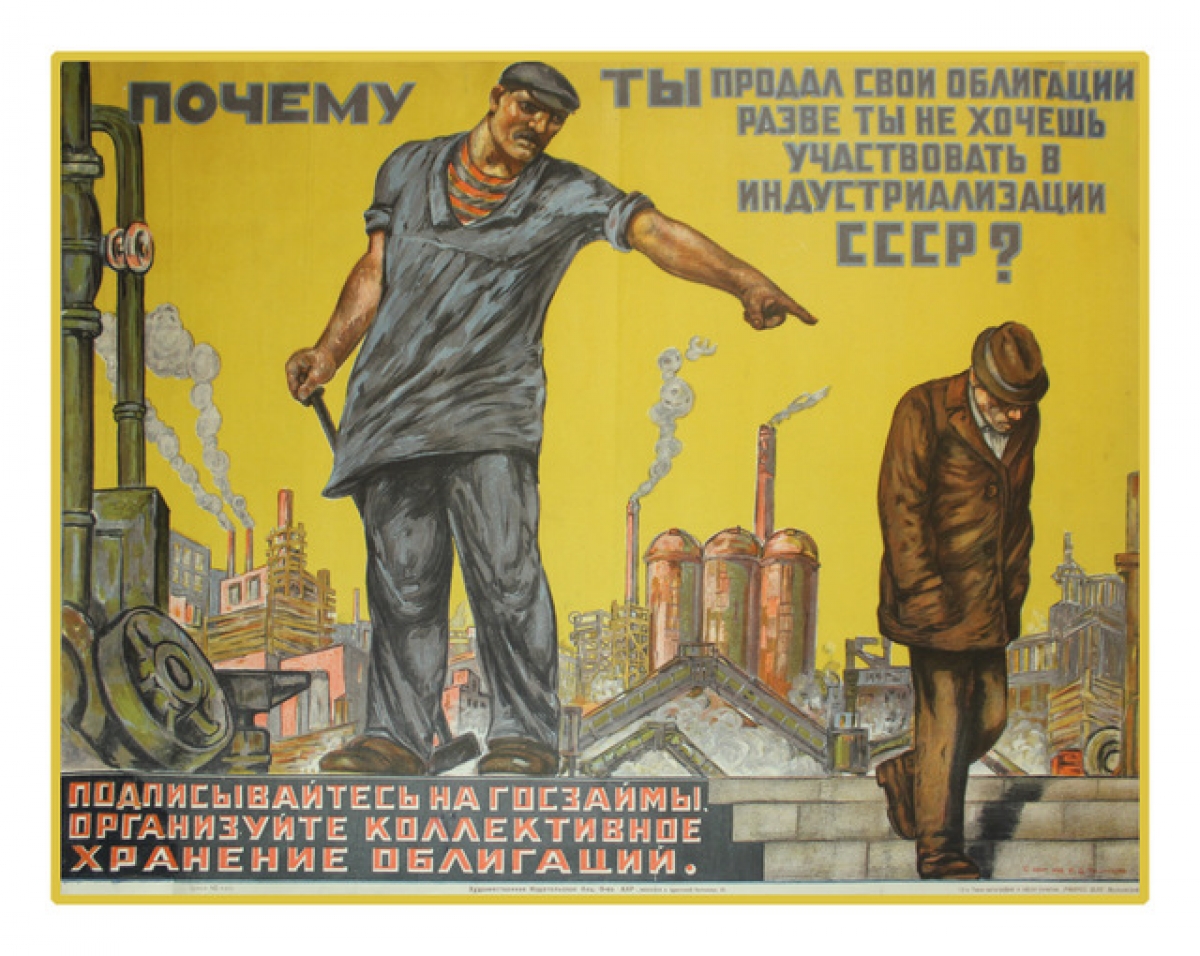
| Why did you sell your bonds Do not you want to participate in the industrialization of the USSR? - circa 1922-30 |

Nazi Germany and Soviet propaganda After the first world war practically every government resorted to intense propaganda campaigns for capturing the hearts and the minds of the masses. In particular, the extreme right in the form of fascism and the extreme left in the form of communism found posters a potent tool in their propaganda campaigns. Here are two examples from Nazi Germany, and Soviet Russia.

During the World War II posters were used for a variety of purposes by all sides. They were used to encourage men to sign up and to encourage women to support their men by working in the factory or by buying war bonds.
It is estimated that the U.S. produced more than 200,000 different posters during the second war, more than any other country. Many of the US war posters were designed by the artists who participated in various competitions to produce a design in support of the war. Many corporations produced posters that while supporting the war was also promoting their products. Many corporations were allowed to treat their war propaganda posters as business expenses.

German propaganda in WWII According to a fascinating article by
Steven Heller :
Hitler’s fervent desire to attain propaganda supremacy among nations was a direct result of the German defeat in World War I and his belief that superior allied propaganda trumped Kaiser Wilhelm II’s meager output. Through intensive barrages of posters and other visual media, Britian and America effectively defamed the “Hun” in the eyes of the world, portraying the Kaiser’s military as callous blood-thirsty beasts. The German counterattack was tepid at best. “The Germans were sent into this mighty battle with not so much as a single slogan,” wrote Eugen Hadamovsky, the Nazi propaganda expert and Josef Goebbels’ deputy, in Propaganda and National Power (1933, reprinted by Arno Press in 1972). So when the Nazis came to power, Hitler commissioned a book titled Das Politische Plakat: Eine Psychologische Betrachtung by Erwin Schockel (Franz Eher Verlag, published in 1939), a psychological assesment of English, American, French, Russian and German political posters. It was a handbook for German propagandists and others. ...
Das Politische Plakat was one in a series of textbooks and manuals issued through the Reichspropagandaleitung, based in Munich (Reich Propaganda Office of the Nazi Party, a separate department from the more powerful Berlin-based Ministry of Propaganda and Enlightenment) for use by party members only. Schockel’s message was clear: powerful propagandistic graphics must be simple and memorable.

Italian Propaganda in WWII  |
| Victory! for the new social order of civilization |
 |
| "Each day of fighting brings us closer to the goal" |
 |
| 'Good blood doesn't lie'. |

Soviet Russia Propaganda in WWII Dmitry Stakhievich Orlov, who was known by his artistic name Dmitry Moor revolutionized the art of propaganda poster in the Soviet Russia. His dramatic treatment of class warfare, with haunting contrasts of then and now, enemies versus heroic allies, imperialism against workers' struggles, to which he added a simplistic slogan: Death to World Imperialism.
Many of Moor's and Deni's posters were restricted to black and red. Red could be used to identify revolutionary elements, particularly flags, worker's shirts and peasant blouses. Black was used for the main drawing and as a solid colour for the clothes of capitalist and priest. His work dominated both the Bolshevik Era (1917–1921) and the New Economic Policy (1921–1927).

“This is a struggle, above all else, for the minds of men.Propaganda is one of the most powerful weapons the Communists have in this struggle. … This propaganda can be overcome by truth—plain, simple, unvarnished—presented by newspapers,radio, newsreels, and other sources that people trust..” President Truman, 1950 in Tuch, 1990, p. 15
When the Cold War came into full form in the late 40s, it was only natural that both the US and the USSR would turn to propaganda war. This was a struggle for people's hearts and minds. In 1948, worried that the American public might become the victim of misinformation produced by its own government, Congress passed the Smith-Mundt Act. This Act outlaws the domestic distribution of U.S. government materials intended for foreign audiences. In 1953, the United States Information Agency (USIA), was founded. It was established as a propaganda agency but it was very careful not to use the word "propaganda" to describe any of its activities.
In order to convince Americans that the US was justified in its new battle, the USIA produced anti-communist propaganda in mass quantities. It became very prevalent very quickly. Anti-communist propaganda could soon be found in every major medium including posters, books, pamphlets, comics, radio, films, and eventually TV.
 |
D. Pjatkin, To Fly Higher Than All, Farther Than All, Faster Than All, 1954,
Published one year after Stalin’s death, this poster reinforces the message that Soviet research and development of weapons and machinery is ongoing. Substantially funded by war reparations from Germany, the Soviets were able to build the MiG-9 Fargo turbo fighter in 1946 and the Yak-15 Feather attack aircraft in 1947. The red stars in the image above symbolise the pilot’s kill score. |
 |
| "Glory to the Soviet warrior!", by Viktor Ivanov, 1947, |
 |
| "We are safeguarding the peace and happiness of our beloved Motherland!", by V. Koretsky, 1947, |
 |
| "Become a member of DOSFLOT! (the Society for Voluntary Support of the Soviet Navy)", by B.D. Velensky, 1948, |
 |
| "Stalin raised us to be faithful to the Soviet people!", by P. Golub, 1948 |
 |
| "The masterminds of a new war ought to remember the shameful fiasco of their predecessors!", by N. Bulganin, B. Efimov, and N. Dolgorukov, 1948 |
 |
| "Glory to Stalin's eagles!", by E.S. Malotetkov, 1948 |
 |
| "Glory to the Soviet People!", by Viktor Ivanov, 1947 |
 |
M. V. Luk'janov and V.S. Karakashev,People and the Party Are Undivided, 1978,
In this poster, banners carried by marching Soviet citizens create a somewhat subtle image of Lenin’s face. The caption reads “People and the party are undivided.” This famous Soviet slogan first appeared in Pravda, the leading newspaper of the Soviet |
 |
B. Reshetnikov, A Mighty Sports Power, 1962
By 1962, sporting events such as the Olympic Games had become hotly contested between the Soviet Union and the USA. Each was desperate to win in order to demonstrate their power and dominance over the other. In the 1956 and 1960 Olympic Games, the Soviet Union was victorious. The character in this poster has been painted to resemble an Olympic torch, with gold medals in the background. |
 |
V. Briskin, Lenin, 1970,
The Soviet Union was keen to promote a positive image of itself throughout the early 1970s against a backdrop of the Vietnam War and a highly volatile relationship with the USA. Posters such as this helped to keep Lenin’s political ideologies alive. With no slogans or foreign words whatsoever, this poster was clearly designed for a European and American audience. |
 |
| “We are with you, Vietnam!” |
 |
Unknown, Jo-Jo The Dove, 1951.
French anti-communist group, Paix et Liberté, created this poster, which openly mocks Stalin’s advocacy of peaceful values. Stalin is depicted as a peace protestor with sinister motives, holding a “Peace” sign in one hand and a bommy-knocker in the other. |

 |
Gennady Andreyevich Zyuganov (Генна́дий Андре́евич Зюга́нов) , First Secretary of the Communist Party of the Russian Federation (since 1993), and Chairman of the Union of Communist Parties - Communist Party of the Soviet Union (UCP-CPSU) (since 2001) reading Pravda -- like Lenin.
Zyuganov quickly emerged as post-communist Russia's leading opposition leader. He argued that the collapse of the Soviet Union led to a decline in living standards, that economic power was left concentrated in the hands of a tiny share of the population, that violent crime increased, and that the Soviet collapse allowed ethnic groups throughout Russia to embark on campaigns, sometimes violent, to win autonomy. |
Soviet Space Program
 |
| Glory to the Fatherland of Heroes! |
 |
| Soviet means excellent! |
Général de Gaulle and the French Fourth Republic:  |
Général de Gaulle, was a French general and politician. He was the leader of the Free French Forces in World War II and head of the provisional government in 1944-46. By the end of 1950s, the French Fourth Republic was tainted by political instability, its failures in Indochina and its inability to resolve the Algerian question. On May 13, 1958, the French settlers seized the government buildings in Algiers, attacking what they saw as French government weakness in the face of demands among the Arab majority for Algerian independence. A "Committee of Civil and Army Public Security" was created under the presidency of General Jacques Massu, a Gaullist sympathiser. General Raoul Salan, Commander-in-Chief in Algeria, announced on radio that the Army had "provisionally taken over responsibility for the destiny of French Algeria". On May 17, De Gaulle announced that he was ready to "assume the powers of the Republic" (assumer les pouvoirs de la République).
The crisis deepened as French paratroops from Algeria seized Corsica and a landing near Paris was discussed. Political leaders on all sides agreed to support the General's return to power, except François Mitterrand, and the Communist Party (which denounced de Gaulle as the agent of a fascist coup). De Gaulle remained intent on replacing the constitution of the Fourth Republic, which he blamed for France's political weakness. He set as a condition for his return that he be given wide emergency powers for 6 months and that a new constitution be proposed to the French people. On June 1, 1958 he became premier and was given emergency powers for six months by the National Assembly.On September 28, 1958, a referendum took place and 79.2% of those who voted supported the new constitution and the creation of the Fifth Republic.
|

French Referendum Poster of the 28th September 1958, on the new constitution proposed by General Charles de Gaulle, September 1958
Poster for the YES vote in the referendum of 1958, created by Lefor and Openo. General de Gaulle often commissioned Lefor and Openo for his campaign posters. Lefor and Openo was a composite name, derived from the names of Marie-Claire Lefort and Marie-Francine Oppeneau, two celebrated designers of commercial and political advertising during the 1955-67 era. The poster depicts Marianne as a round-faced young woman, with big hopeful eyes and captivating smile, looking confidently into the future, which seems to have been inspired by Brigitte Bardot's image. Marie-Claire Lefort and Marie-Francine Oppeneau appears to used the same idea in their poster created for Bardot's film "Babette goes to war".
Poster for the No vote in the referendum of 1958, commissioned by the French Communist Party.
 |
Poster of the campaign for European Defense Community(EDC).
The EDC, was a French project devised by Paris to prevent the entry of Germany into NATO. According to Victor Gavin in his paper "What Kind of Europe within the Atlantic Community? Britain and the European Defense Community 1950-54," Germany posed the main problem for British, French and Americans. The British did not want Germany to enjoy full freedom of action, and felt that one of the few merits of the EDC was that it would exercise control over Bonn’s security policy. The prospect of a rearmed Germany was not very popular,though the British Joint Chiefs of Staff had come to the same conclusion as the US about the impossibility of defending Europe without German participation. The British Government was ready to accept the proposal of Chancellor Adenauer to create a federal police force, but no more than that.
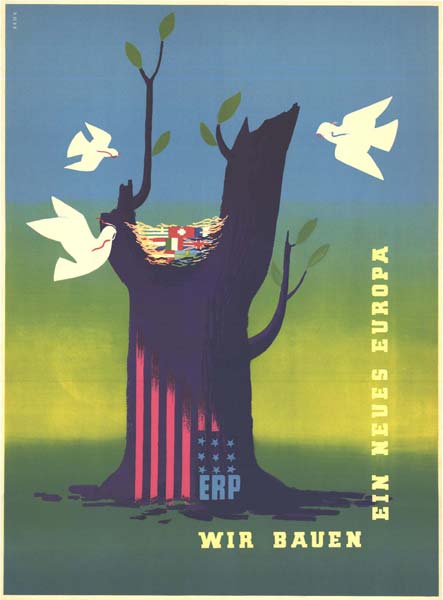
The position of French is best articulated by a French embassy staff in London, Monsieur Lebel, who stated bluntly that “the French were still scared to death at the thought of a revived German army.” The US did recognize that, politically and economically, Europe was very poorly organized, and all of her problems could be attributed to its division into a mosaic of nation-states, each one seeking constantly to safeguard its own particular interests to the detriment of the most elementary criteria of rationality and efficiency. For Washington it was necessary to find a formula that combined efficiency with containment on two fronts, on both Soviet expansionism and of the new West Germany. Germany was to be progressively released from the punitive policies of the immediate post-war period, and its integration into the new Europe would allow both mechanisms to control its progress and the benefits from its economic recovery to be shared by all. Indeed, the US made their support for the political and economic recovery of Europe contingent on a relaxation of state borders and the overcoming of the narrowness of the nation-state mind-set, a change that the US regarded as vital not only for overcoming ancient hatreds but also for the efficient management of European resources in the Cold War.
In the words of the British scholar Timothy Garton Ash, there was a need to find a formula to replace the control derived from a policy of punishment with a set of ‘golden handcuffs’. Nevertheless, London saw itself as a power with world responsibilities derived, essentially, from its colonial empire, and thus it could not focus exclusively on questions concerning Europe. At the NATO Council meeting in Paris on 14 December 1953 John Foster Dulles, US Secretary of State,threatened an “agonizing reappraisal” of US policy if the EDC was not ratified,a declaration that led the Foreign Office to understand the scale of the US commitment to the EDC as part of its overall strategy for European defense. It was a particularly difficult moment for London. Everything seemed to indicate that if the EDC was not ratified, the United States would reassess its commitment to the defense of Europe. The pressure on France was ineffective because Paris, unlike London,correctly saw the US threats as a bluff; the French thought it inconceivable that at the height of the Cold War Washington was ready to yield, even temporarily, all the resources of Western Europe to the Soviet Union should Moscow attack. If France stayed firm, how long could Britain hold out?
At the end, the EDC treaty was not ratified by the National Assembly in Paris on 30 August 1954. Instead, during September-October of the same year the British led the way to transform the Treaty of Brussels organization into the Western European Union in 1955. West Germany accepted the limitations of putting all her troops under the authority of the NATO supreme commander and of not developing, possessing or storing atomic, chemical or bacteriological armaments. |


The winner of the poster competition, Maria Mileńko from Poznań, Poland
Young Fine Gael, the autonomous wing of the Irish party, launched the above poster for the YES vote to the Lisbon Treaty. The above two posters, targeted male and female voters, with the slogans: 'Enlarge your opportunities, vote yes to Lisbon' and Increase your prospects, vote yes to Lisbon'. Ireland voted “no” to the Lisbon Treaty on 12 June 2008, by 53.4% to 46.6%. The poll was a major blow to the EU leaders, which required all its members to ratify the treaty. European Commission President Jose Manuel Barroso said he had spoken to Mr Cowen and agreed with him that this was not a vote against the EU! "Ireland remains committed to a strong Europe," he said.
Nevertheless, Ireland passed Lisbon Treaty in second referendum on October 2nd 2009, paving way for EU integration.
The Front National campaigned against the EU. On July 2012, they issued a communique criticizing François Hollande's proposal to go further on the path of European federalism as a direct affront to national independence and sovereignty of France.
After the recent announcement by the socialist of one more step towards a federal Europe, it is now becoming difficult to give a meaning to the wording of Article 3 of the DDLC of 1789: "The principle of all sovereignty resides essentially in the Nation "or to that of Article 3 of the 1958 Constitution, which clearly declares the democratic principle: " National sovereignty belongs to the people who exercise it through their representatives and by means of referendum.
'
Ukraine's “Europe without Barriers” public initiative conducted an information campaign: "Choose a better life! " Live without barriers " and "No visa regime! Europe is our home” aimed to explain the benefits and features of visa-free regime in relations with the EU to Ukrainian citizens.
 |
On October 2012, in a move interpreted by some as a job application, the former British prime minister Tony Blair declared the EU could do with a strong leader approved by the people. He also warned that too deep a political divide between Britain and the core Eurozone countries could lead towards a break-up. "Out of this European crisis can come the opportunity finally to achieve a model of European integration that is sustainable," said Mr Blair. "A Europe-wide election for the presidency... is the most direct way to involve the public." Europe's millions of residents might feel "alienated" unless they have a direct say in who is governing them, Mr Blair told the Nicolas Berggruen Institute on Governance. "An election for a big post held by one person - this people can understand," he said. "The problem with the European Parliament is that though clearly democratically elected, my experience is people don't feel close to their MEPs."
In June of that year in an interview with the Financial Times Weekend magazine he had said: "I sometime wish now that when the presidency came up, I would have taken that position - and actually gone out on a more public campaign about what I thought about Europe". |
 |
On September 2009, a reader, in response to an inquiry by Mailonline, asking "Should Tony Blair become EU President?" wrote:
In my opinion It would be a disastrous decision if Tony Blair was made EU President. When in government he rough shod over Parliament, he took us into Iraq costing many lives, he took us into Afganistan,His party promised that the UK would have the referendum on the EU Constitution, Did we get it. No! Public opinion means nothing to this man and his past policies are still costing the lives of our young men. For Tony Blair to be given this position would be disastrous for all of Europe and beyond. |
 A comparison of these British propaganda posters of the Second World War against those of the other belligerent countries, under tyrannical dictatorships would be somewhat revealing. The British posters depict the war time Prime Minister Winston Churchill, presented as a thoughtful leader with a calm determination, who is offering his personal support and encouragement. However, the propaganda posters of the Soviet Union under Lenin or Stalin, Nazi Germany under Hitler, and Fascist Italy under Mussolini, the posters appear to be contributing to a build up of the cult of personality.